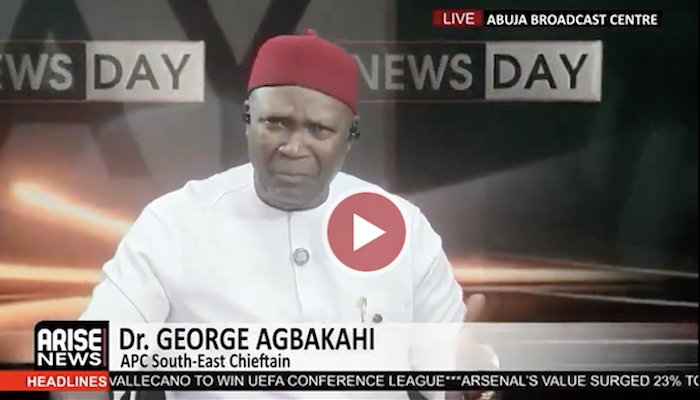
APC South East chieftain, Dr George Agbakahi, has defended President Bola Ahmed Tinubu’s economic reforms, arguing that the administration’s policies have helped stabilise Nigeria’s economy despite ongoing hardship and public criticism.
Speaking during an interview on ARISE News, Agbakahi said President Tinubu inherited an economy facing severe structural problems, particularly fuel subsidy payments and multiple exchange rate systems.
“Tinubu’s economic reforms have stabilised Nigeria’s economy,” he said.
According to Agbakahi, the removal of fuel subsidy and the unification of exchange rates were necessary decisions aimed at correcting long-standing economic distortions.
“President Tinubu came on board as a bold and courageous leader,” he stated.
He stated that the fuel subsidy regime before Tinubu’s administration drained public finances and encouraged corruption.
“Nigeria spent about ₦12 trillion on fuel subsidy,” he said.
Agbakahi also criticised the previous multiple exchange rate system, describing it as vulnerable to abuse and financial leakages.
“It was full of corruption,” he stated.
According to him, the reforms have significantly increased government revenue generation across key agencies.
“FIRS was generating mere ₦11 trillion before; currently it is generating ₦28.3 trillion,” he said.
He added that agencies such as the Nigeria Customs Service and NIMASA had also recorded major increases in revenue since Tinubu assumed office.
“There has been increase in revenue generation,” he stated.
Agbakahi maintained that the administration’s reforms are beginning to produce results across sectors including education, youth empowerment, agriculture, and healthcare.
“There have been tangible and intangible gains,” he said.
He pointed to the student loan programme as one of the administration’s achievements in the education sector.
“Almost ₦250 billion has been disbursed to students,” he stated.
According to Agbakahi, the government has also expanded technical and vocational education programmes to support youth employment and skills development.
“About 650,000 youths are beneficiaries,” he said.
He explained that the administration is focusing not only on white-collar employment but also on vocational training and entrepreneurship.
“The government is interested in technical and vocational education,” he stated.
On insecurity, Agbakahi acknowledged ongoing security challenges but insisted that the Tinubu administration has invested heavily in military equipment, logistics, and welfare for security agencies.
“The president has provided arms, ammunition, and helicopters,” he said.
According to him, insecurity predates the current administration and cannot be blamed entirely on Tinubu’s government.
“Insecurity did not just start in this administration,” he stated.
Agbakahi further stated that security conditions have improved in parts of the South East and South South regions.
“The insecurity situation has reduced tremendously in some areas,” he said.
He also claimed that security agencies have neutralised and arrested large numbers of insurgents and criminal elements.
“A lot is happening,” he stated.
But, Agbakahi suggested that some narratives surrounding insecurity may also be politically influenced.
“Some of these things are politically motivated,” he said.
Agbakahi concluded that despite ongoing hardship and security concerns, President Tinubu’s reforms have strengthened government revenue, stabilised key sectors of the economy, and laid foundations which the APC believes justify seeking a second term in office.
Ojo Triumph