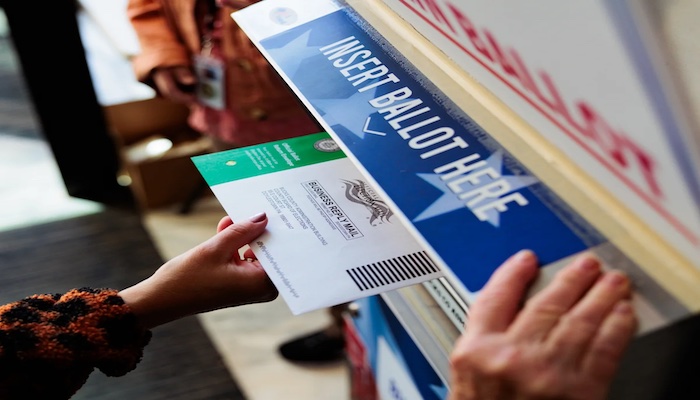
A US judge on Thursday declined to block President Donald Trump’s executive order tightening rules on mail-in voting, dealing a setback to the Democratic Party, which argued that the measure could disenfranchise millions of voters ahead of the November midterm elections.
The ruling comes as Republicans and Democrats prepare for a closely contested battle for control of both chambers of the US Congress. Trump has repeatedly claimed, without evidence, that his 2020 election defeat was caused by widespread voter fraud and has long criticised voting by mail.
The executive order, signed by Trump on March 31, directed his administration to compile a list of confirmed US citizens eligible to vote in each state and to use federal data to help state election officials verify voter eligibility.
The order also instructed the US Postal Service to deliver ballots only to voters appearing on each state’s approved mail-in ballot list and required states to preserve election-related records for five years.
In rejecting a request for a preliminary injunction sought by plaintiffs including Senate Minority Leader Chuck Schumer of New York, Washington-based US District Judge Carl Nichols ruled that the challenge had been brought too early because federal agencies had not yet implemented the policy.
“Given that the Executive Order does not command Plaintiffs to do anything, and that no agency has yet acted pursuant to the Order in a way that could harm Plaintiffs, they have not suffered any harm at present,” wrote Nichols, who was appointed by Trump during his first term.
The judge added that Democrats could return to court to seek an injunction after federal agencies took concrete steps to enforce the executive order.
Democrats argued that the order infringed on states’ constitutional authority to regulate elections. They also warned that the directive requiring agencies to use Department of Homeland Security and Social Security Administration data to build “state citizenship lists” could wrongly exclude legally registered voters because the databases may contain outdated or inaccurate information.
The Justice Department, however, countered that the litigation was premature because no actual harm had yet occurred.
A coalition of Democratic-led states has also filed a separate lawsuit challenging the executive order in federal court in Boston. U.S. District Judge Indira Talwani, an appointee of former Democratic President Barack Obama, is scheduled to hear arguments in that case on June 2.
Boluwatife Enome