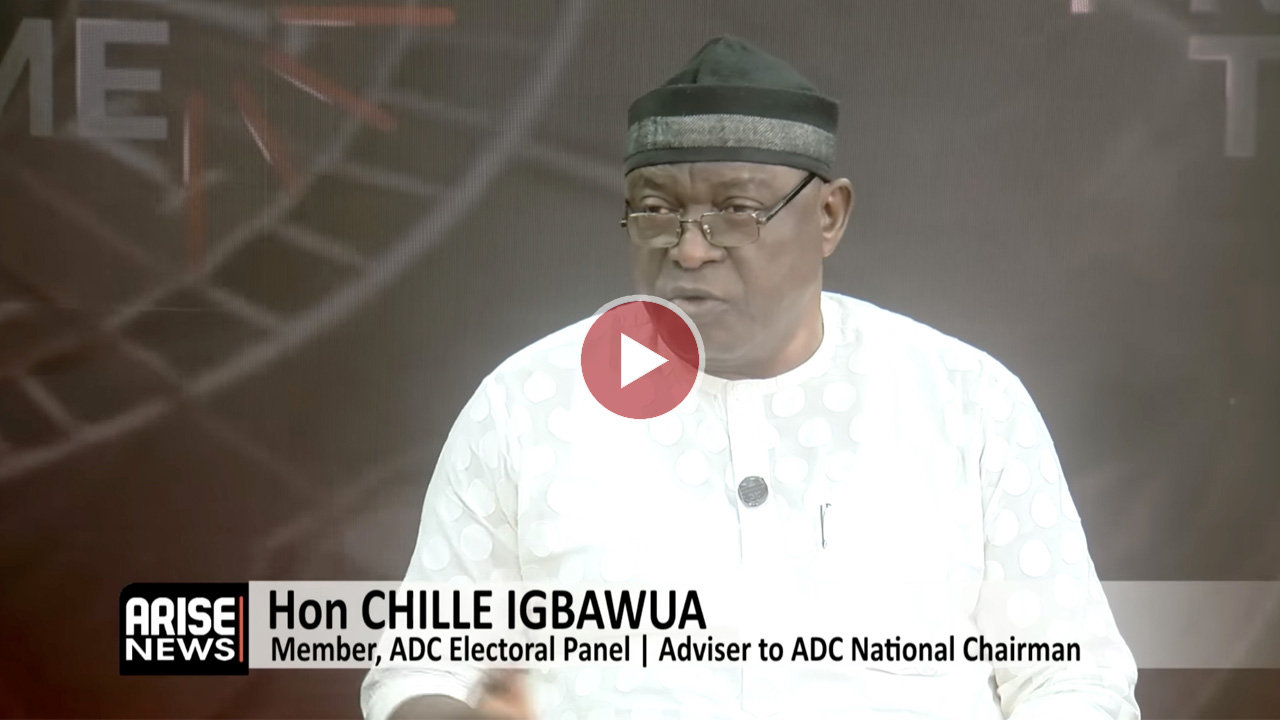
A member of the African Democratic Congress’s electoral panel, and also an advisor to the ADC’s national chairman, Honourable Chille Igbawua, has urged caution over allegations of vote rigging in the party’s presidential primary, insisting that claims of electoral malpractice must be backed by evidence before any conclusions are drawn.
“”I wouldn’t succumb to that opinion at this stage until I see, because vote rigging can come through several methods,” he stated.
Speaking in an interview with ARISE NEWS on Tuesday, he maintained that the credibility of the process can only be properly assessed after a thorough review of the results and reported irregularities, while assuring that the ADC will review these allegations.
“At this point, we’ve heard a general accusation that there were irregularities, and in what form we don’t know yet. But we expect that the party will look at it because this is not the last election we’re going into. And the party is very keen on ensuring that when it puts its processes into action, it will analyze after it to see whether they went well as planned,” he assured.
Igbawua declined commenting on the credibility and transparency of the ADC presidential primary, saying it would be premature to make a definitive assessment while results were still being collated.
“As we speak, the results are still coming in, and we’re seeing one candidate winning here, losing there, winning there, losing there. So we cannot give a correct assessment until we have the full results and then we’re able to analyze them based on some parameters that would quickly tell you whether or not things went awry,” he said.
However, he revealed that reports received from 14 states showed Atiku Abubakar leading in overall votes, although other aspirants, including Mohammed Hayatu-Deen and Rotimi Amaechi, had recorded victories in some states.
“Yes, it’s true Atiku is leading. As at the time I left the Congress Hall where the collation is being done, we had received reports from 14 states. Other states are being awaited. But he was leading in most of the states, though each of them won in some other states too. Hayatu-Deen won in some states, Amaechi also won in some states, but in terms of quantum of votes, Atiku was leading,” he shared.
Dismissing suggestions that the party had secretly adopted a consensus candidate, Igbawua stressed that all aspirants were aware the ADC had opted for a direct primary after efforts to reach a consensus failed. According to him, the decision was communicated clearly to contestants and party members in line with provisions of the Electoral Act.

“The issue is that ADC chose to go for direct primary, not consensus. And this was made very clear to everyone, not just those who were going into the elections, but the dramatis personae in the competition. They had meetings—work for consensus—it didn’t work out. And the Electoral Act is very clear. Where contestants refuse to go into consensus, you must have a direct election, a direct primary,” he explained.
Responding to allegations by former Transportation Minister Rotimi Amaechi that as much as 80 per cent of party members were disenfranchised, Igbawua said voting was conducted at the ward level using existing party registers and that the process was documented through videos submitted from across the country.
“All elections were conducted at the ward level. That is where party registers reside. So at the ward level, those who came out lined up for the candidates of their choice. And even as we sat there, we were seeing videos—and this was encouraged.”
While acknowledging that some cases of disenfranchisement could have occurred, Igbawua said there was no evidence to support claims that the problem was widespread or deliberate.
“I do not argue that there may be some element of disenfranchisement, but I also do not succumb to the opinion that over 80 or even up to 80. I don’t think it would be of that magnitude. And I do not also think that it would be deliberate,” he said.
He maintained that the party took measures to ensure transparency and insisted that members were fully aware that a direct primary, rather than a consensus arrangement, would determine the party’s presidential candidate.
“It was made clear that we’re not going to consensus; we’re going for direct elections—clear reasons because ADC is not doing congresses, ADC is not doing conventions. That was the only alternative left to the ADC, and it was made very clear to everybody that you’re going for direct elections, there will be no congresses, there will be no convention,” he insisted.
On how complaints arising from the ADC primaries would be handled, Igbawua said the ADC had established appeal panels to review grievances at every stage of the process.
“First and foremost, the various electoral panels had appeal panels on ground,” he said.
He urged aggrieved aspirants to utilise the party’s internal dispute-resolution mechanisms rather than prematurely rejecting the outcome of the exercise, noting that the appeal process was specifically created to address any errors or irregularities that might arise during the conduct of party primaries.
“If you felt that you were screened out unfairly, you would go to an appeal panel, and they would look at your case,” he urged.
Emphasising the competitiveness of the process, Hon. Igbawua said the ADC primary was open to all aspirants on equal terms.
“I think it was level,” he said.
Igbawua dismissed suggestions that Peter Obi’s departure from the party was a wise or strategic move, saying it was a personal choice.
“No, I don’t think this is a matter of being mired. Where he has gone to, all the best, but I don’t think that to me he made the right choice.”
Addressing the possibility of reruns or audits, he said the party’s appeal panel was the proper channel for handling complaints arising from the primary and could recommend corrective action where necessary. He added that any such decisions would depend on time and procedure.
“That is the essence of the Appeal Panel. Subject to time—because we’re not in charge of the time, as you know—there are some things that can be done if there’s time. I’m very sure about that. So, if the complainants go to the Appeal Panel, I’m sure they will have justice from there and there will be some recommendations on what should be done to correct the anomaly if one is found. I believe that within the time available, that can be done,” he stressed.
Addressing concerns over a parallel faction allegedly presenting Dumebi Kachikwu as its presidential candidate, Honourable Igbawua dismissed the development as legally unfounded and not recognised by the party’s leadership or relevant authorities.
“Whatever is being fashioned against the ADC—whether in the courts or elsewhere—is from the outside. The process is very clear. Dumebi Kachikwu was the presidential candidate of this same ADC, the ‘legacy ADC,’ in the last elections. Even before he could put his foot forward, he was expelled by the party because they said he had violated the rules of the party. Now, he went to court, and the court has dismissed his case. So, with respect to that, that’s what it is.
“We don’t think there are any issues with those cases of parallel leadership. We don’t have any fears about the integrity and the legitimacy of the leadership of the ADC,” he insisted.
Favour Odima.