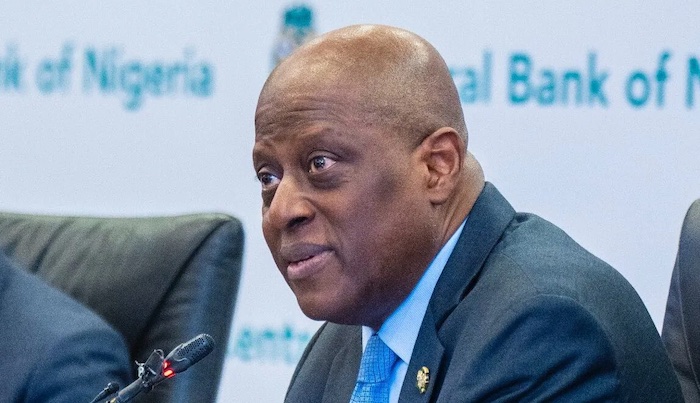
Central Bank of Nigeria (CBN) on Wednesday resolved to retain the Monetary Policy Rate (MPR), the benchmark interest rate, at 26.5 per cent, and the standing facilities corridor around the MPR at +50/-450 basis points.
The central bank also kept all other primary policy parameters, leaving the Cash Reserve Requirement (CRR) for Deposit Money Banks (DMBs) unchanged at 45 per cent, merchant banks at 16 per cent, and 75 per cent for non-TSA public sector deposits.
Speaking at the end of the two-day, 305th, meeting of the Monetary Policy Committee (MPC) in Abuja, CBN Governor, Mr. Olayemi Cardoso, said the decision to hold policy rate was anchored on a comprehensive assessment of the risks to the outlook.
Cardoso said although inflation had risen marginally, for two consecutive months, largely induced by external shocks, MPC recognised its transitory nature and remained confident that the current macroeconomic environment was sufficiently robust to support a return to disinflation.
Reacting to the MPC resolutions, Centre for the Promotion of Private Enterprise (CPPE) hailed the apex bank’s decision to hold monetary policy parameters constant.
CPPE Chief Executive, Dr. Muda Yusuf, said the bank’s decision reflected a pragmatic, measured, and increasingly sophisticated understanding of the inflation dynamics currently confronting the Nigerian economy.
The CBN governor particularly referenced the spill overs from the Middle East crisis, which had exerted upward pressure on energy prices and cost of transportation.
He said available evidence indicated that the effect of the crisis on the Nigerian economy had been largely muted due to the benefits of prior policy reforms.
Cardoso, who read the committee’s communique, listed the policy interventions to include exchange rate stability, improvements in external reserve buffers, strengthened monetary policy transmission, a well-capitalised banking system, and ongoing fiscal consolidation, which had significantly enhanced the economy’s ability to absorb external shocks.
Cardoso stated, “As a result, the pass through of global commodity and energy price shocks to domestic inflation has been significantly mitigated and would have been more pronounced in the absence of these reforms.”
He said MPC was convinced that the essential conditions for price stability remained firmly in place.
The committee also welcomed the recent sovereign rating upgrade amid prevailing external headwinds, stating that the development underscores the strength of the country’s macroeconomic fundamentals and reinforces confidence in its reforms.
However, the central bank governor pointed out that headline inflation, year-on-year, rose marginally for the second consecutive month to 15.69 per cent in April 2026, from 15.38 per cent in the preceding month, largely driven by an increase in the food component.
Food inflation rose to 16.06 per cent in April 2026, from 14.31 per cent in March, reflecting the high cost of transportation and other logistics factors.
Core inflation moderated to 15.86 per cent in April 2026, from 16.21 per cent in March.
Similarly, the 12-month average inflation slowed to 19.16 per cent in April 2026, from 20.05 per cent in March, marking the sixth month of consecutive decline.
Month-on-month, headline inflation also eased to 2.13 per cent in April 2026, compared with 4.18 per cent in March 2026, reflecting moderation in both food and core components.
MPC called for a cautious and vigilant policy stance to anchor inflation expectations and safeguard macroeconomic stability.
Cardoso highlighted the committee’s satisfaction with the successful conclusion of the banking recapitalisation exercise, which culminated in the emergence of 33 banks with stronger financial soundness indicators, enhancing their capacity to support the economy.
MPC urged the central bank to remain proactive and adopt necessary measures to address potential post recapitalisation risks towards preserving financial system stability.
According to the CBN governor, gross external reserves remains robust at $49.49 billion, as of May 15, 2026, compared to $48.35 billion at end March 2026, sufficient to cover 9.04 months of imports for goods and services.
He said, “This strong buffer continues to reinforce investor confidence in the Nigerian economy and support exchange rate stability.”
In its outlook, CBN stated that growth was expected to remain resilient in 2026, despite emerging downside risks associated with the Middle East conflict.
Cardoso said, “Available projections indicate a moderate increase in inflation in the near term. However, the combined effects of previous policy tightening, exchange rate stability, and enhanced food supply are expected to support the return to disinflation.
“In light of evolving domestic and global uncertainties, the committee reaffirmed its commitment to a forward looking and evidence based policy framework anchored on its primary mandate of achieving price stability while preserving the soundness and resilience of the financial system.”
Commenting on measures being taken by the apex bank to curtail imported inflation and stabilise prices, Cardoso said, “Basically, we have to remember that we have been coming from 11 straight months of disinflation.
“We believe that what we have now is something that has resulted from external shocks. But notwithstanding that, we have been able to create buffers that have protected us during this period. Of course, the Standard & Poor’s upgrade is further testimony to the fact that we are clearly adopting policies that are taking us in the right direction.”
He added, “The answer to that clearly is that we will continue on that path. We will sustain the course. We have seen that as a result of adopting the right policies, we have consistently been on the path of disinflation. This, we believe, is temporary, and in due course, we should go back to the trend we had embarked upon, largely due to the tools that we had adopted.
“So we will continue in that light. In addition to that, of course, it is key that the centrepiece of our toolkit which is ensuring that the foreign exchange rate remains stable. That is something we are committed to ensuring, so that collaboration is strengthened and potential pass through is minimised.”
On the recapitalisation exercise and fate of other remaining banks under regulatory forbearance and yet to meet the new capital threshold, the central bank governor said, “And if you notice, much of what has come out of the banking recapitalisation exercise, which saw the emergence of 33 banks meeting that requirement, is one that shows the resilience of Nigeria investors. The belief investors have in our economy, given the fact that the ratio was about 74 per cent to 26 per cent or thereabouts.
“So, that also shows a great interest in investing in Nigeria, and I think that is something Nigerians should be very proud of. They should be very, very proud of it. And, of course, what you see is that the recapitalisation exercise has gone on relatively seamlessly.
“The banks you talk about are banks that have been subjected to various forms of legal, regulatory and judicial issues, and they are ones that, in the fullness of time, will be in a position to move forward on that recapitalisation trajectory.”
Cardoso explained, “Bearing in mind also that at a particular point in time when the central bank had cause to intervene, some of the time that they would have had, similar to what the other banks had, was taken away from them.
“So, it would be unfair to compare them in terms of timing to what the other banks have been able to do within that limited time that we gave them.
“However, we are fully on top of all of the banks that are still on that road of travel, and there is business continuing as usual. And we support all the efforts that they are making towards getting over the regulatory and legal impediments in the area.”
The CBN governor stated that the current goal of the apex bank was to achieve $1 billion daily FX turnover.
He said, “We definitely will get there. With some of the reforms that have been undertaking and some of the things you will see in the FX Manual, we are confident that as time goes along, we will get to that level.
“When this administration took over, foreign exchange turnover on a daily basis was about $1 million. As of today, it is about $55 million. At times, it has been as high as $1 billion on a daily basis, not every day, but it has happened.”
Reacting to the latest MPC decisions, CPPE said, “The outcome of the 305th MPC meeting reflects a balanced and intelligent policy calibration that appropriately recognises that the ultimate objective of macroeconomic management is not merely to tame inflation statistics, but to create an environment that supports investment, productivity, competitiveness, industrialisation and sustainable job creation.”
Yusuf said at a time of heightened global uncertainty and mounting geopolitical tensions, the decision of MPC had sent a powerful signal of policy maturity, strategic restraint, and confidence in the direction of macroeconomic management.
He said the current inflationary pressures were substantially structural, externally induced, and being driven more by supply-side disruptions than by excess domestic demand.
According to him, “Monetary policy is a powerful stabilisation instrument, but it cannot repair supply chains, resolve geopolitical conflicts or eliminate structural bottlenecks in production and distribution.
“Attempting to force down structural inflation solely through aggressive monetary tightening would amount to applying a monetary solution to a structural problem.
“The decision to hold rates, therefore, demonstrates a commendable recognition that excessive tightening at this stage could suffocate productivity, weaken industrial recovery, constrain investment appetite and undermine employment generation.”
Yusuf pointed out that economies did not grow on the strength of high interest rates but “on the strength of productivity, enterprise, investment confidence and policy coherence”.
He said CPPE particularly commended CBN for the increasingly disciplined management of the monetary policy architecture and the relative stability achieved in the foreign exchange market over the recent months.
Yusuf said a stable currency environment “improves investors’ sentiment, moderates imported inflation, enhances planning predictability and reduces speculative distortions within the market”.
He stated that the recent policy direction of the apex bank reflected a transition from crisis management to confidence management, which was critical for restoring macroeconomic credibility, and rebuilding investor trust in the Nigerian economy.
The CPPE chief executive stated, “We also commend the fiscal authorities for the renewed commitment to fiscal consolidation and improved revenue performance.
“The sustainability of macroeconomic stability ultimately depends on the quality of fiscal discipline.
“Rising revenues should translate into lower fiscal deficits, reduced dependence on debt financing and stronger fiscal buffers.”
James Emejo and Nume Ekeghe, Dike Onwuamaeze