The Gauteng government is reviewing a major policy that shifted responsibility for municipal accounts from the province to schools, amid mounting debt, service disconnections and concerns over the impact on teaching and learning.
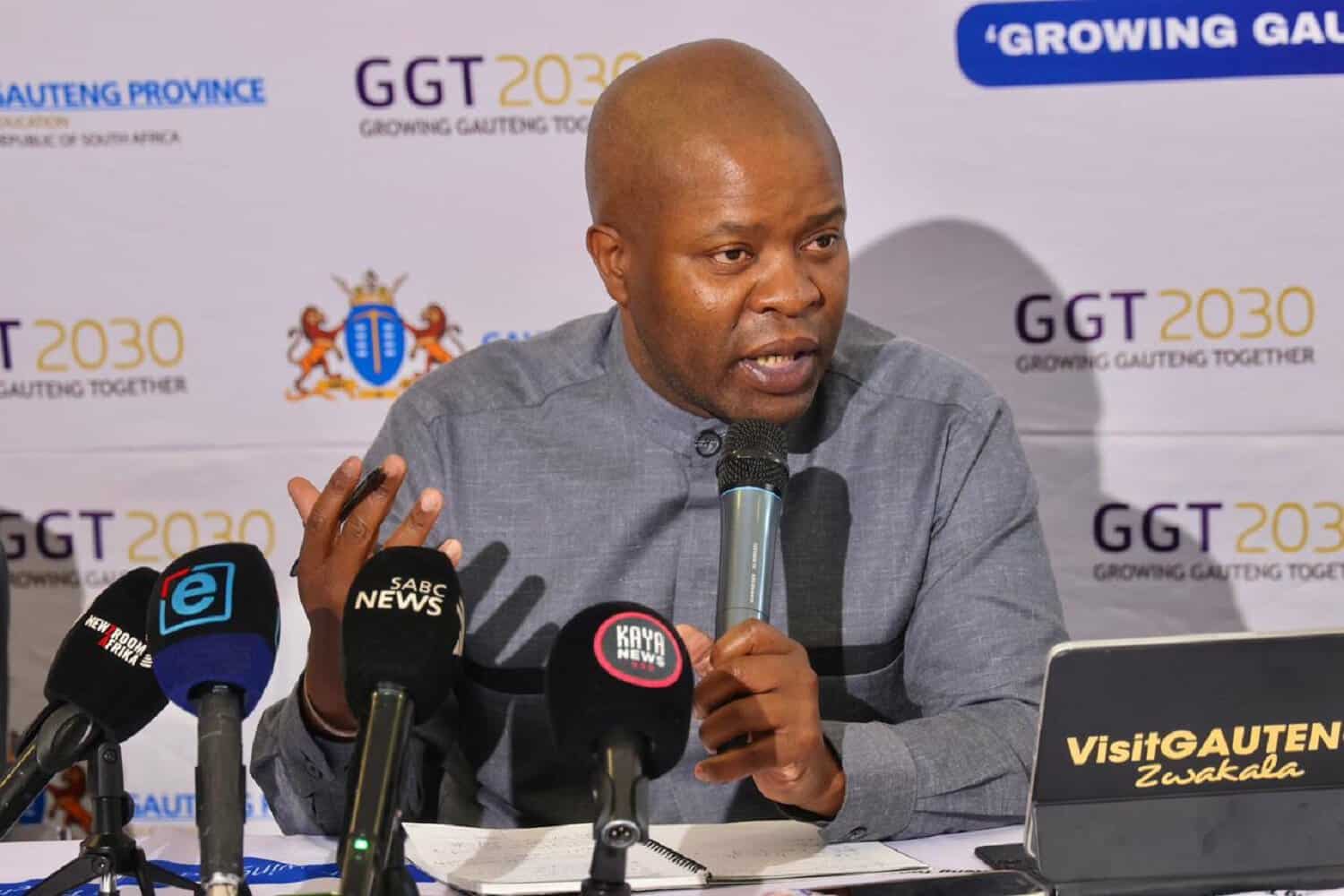
Speaking during a media briefing on Sunday, Gauteng Education MEC Lebogang Maile said the province was reassessing the decentralisation model adopted by the Gauteng Department of Education (GDE), which gave schools and school governing bodies (SGBs) responsibility for paying for services such as electricity, water, sanitation and refuse removal.
The review comes after the Pretoria High Court ordered the City of Tshwane earlier this month to immediately restore electricity to schools disconnected over unpaid municipal accounts.
Gauteng reviewing decentralisation model
Maile said the decentralisation system was introduced to promote “financial autonomy and accountability at school level”, particularly at Section 21 schools.
Under the model, schools receive allocations from the department and are expected to manage and pay their own municipal accounts.
“The approach has been referred to by scholars as ‘breaking to build’ – a concept that argues that decentralisation can be an effective mechanism in national unity,” Maile said.
“In the context of education, ‘breaking to build’ is about ensuring that decisions are made closer to the point of action, thereby reducing bureaucratic delays and building more stable schools while promoting efficiency in their governance.”
He said the model was intended to allow schools to make faster financial decisions, improve procurement flexibility and strengthen accountability through SGB oversight and annual audits.
However, Maile said the system had created severe financial and governance challenges for schools.
“For this reason, we are reviewing the decentralisation model. This has been made necessary by the impediments that it has posed, particularly as it pertains to challenges with financial management and sound governance, which result in the non-payment of municipal services.
“We are in the process of engaging with the necessary stakeholders to assess what can be done to strengthen teaching and learning while mitigating and eliminating the challenges that we have outlined herein,” he said.
Nearly R600m owed to municipalities
The province revealed that as of the end of March 2026, Gauteng schools owed municipalities R583.9 million in debt more than 60 days old.
The City of Johannesburg accounted for the biggest portion of the debt at R390.71 million, followed by the City of Ekurhuleni at R75.14 million and the City of Tshwane at R51.7 million.
Schools also owe Eskom R6.32 million.
Maile said many schools, particularly no-fee and low-income schools, struggled to keep up with rising municipal tariffs while operating on limited budgets.
“Some schools inherited historical municipal debt that accumulated before the decentralisation policy was implemented,” he said.
The MEC added that municipalities had also been accused of overcharging schools through estimated billing, incorrect meter readings, and inappropriate tariff classifications.
“Some public schools allege that they are billed under business or commercial tariffs instead of educational or public service tariffs,” he said.
“Commercial tariffs are substantially higher and place severe financial strain on schools already operating under limited budgets.”
Court ruling on school electricity disconnections
Maile welcomed the Pretoria High Court ruling ordering the restoration of electricity to schools in Tshwane.
“The ruling prohibits further power cuts, confirming that schools should not face disconnection for property rates owed by authorities,” he said.
“Education services are not a privilege that is extended on the basis of financial ability. Education is a constitutionally enshrined right.”
He said the Gauteng government recognised municipalities’ financial pressures but warned that disruptions to electricity and water services had devastating consequences for schools.
“Schools without electricity cannot operate computer labs, lighting, or administrative systems, while water cuts create sanitation and health risks for students and staff,” he said.
The MEC said municipalities across Gauteng had assured the provincial government that they would comply with the court ruling while working with the province to resolve disputes over billing and debt.
Overcrowding and infrastructure pressures
The review of decentralisation comes amid broader pressures facing Gauteng’s education system, including overcrowding, infrastructure backlogs and rapid in-migration into the province.
According to the province, learner numbers in Gauteng public schools have doubled since 1995, increasing from 1.4 million to more than 2.8 million students in 2026.
Maile said fiscal constraints, vandalism, crime, and the cost of building schools on dolomitic land continued to strain the education system.
While the provincial education infrastructure budget increased from R1.63 billion in the 2021/2022 financial year to R2.84 billion in 2025/2026, Maile said this remained insufficient to address growing backlogs.
“Ultimately, schools must focus on the core mandate of delivering the curriculum successfully,” he said.
“Administrative functions must be performed by expert personnel to prevent governance failures and other factors that may obscure the focus of School Management Teams and School Governing Bodies.”