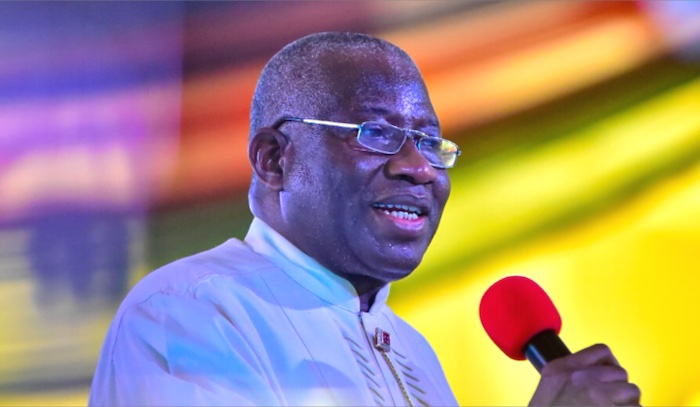
Former President Goodluck Jonathan Saturday expressed confidence that Nigeria would overcome its current economic, social, and security challenges, even as the Church of Nigeria (Anglican Communion) warned political leaders against abandoning governance for early permutations ahead of the 2027 general election.
The former president’s strong interventions came at the ongoing First Session of the 13th Synod of the Diocese of Abuja held at St. James Anglican Church, Asokoro in the nation’s capital, where the Anglican Church delivered a sweeping State of the Nation address on the economy, insecurity, corruption, electoral integrity and rising social decay.
The Synod, presided over by the Primate of the Church of Nigeria and Bishop of Abuja Diocese, Henry Ndukuba, cautioned the Independent National Electoral Commission (INEC) against partisanship and urged political actors to focus on governance rather than “toxic political manoeuvres” ahead of the next electoral cycle.
Jonathan, who spoke at the ceremony attended by former Head of State, Gen. Yakubu Gowon (rtd), Senator Ireti Kingibe, bishops, clergy, and government officials, said the church remained one of the strongest institutions holding Nigeria together during difficult times.
He lamented what he described as a deepening moral decline in society, rising violence, and the erosion of values among young people, warning that the country faced increasing social pressures, partly fuelled by the misuse of technology and social media.
“The decadence in society is so high that the church has to double its efforts through prayers and conduct to help build a normal society for our children,” Jonathan said.
The former president, however, maintained that Nigeria would eventually overcome its challenges through focused leadership, patience, and collective commitment.
“I believe that as a country, we will get over our challenges. God will not abandon Nigeria,” he added.
Drawing lessons from the economic transformation of countries such as Singapore and other Asian Tigers, Jonathan said national development required long-term planning and consistent leadership.
“What I noticed was that it took between 30 and 40 years for these countries to move from where we are now to near first-world status. Progress takes time, but it also takes good and focused leadership,” he stated.
In its State of the Nation address, the Anglican Church expressed concern over what it described as increasing political desperation ahead of 2027, saying many political leaders appeared more interested in power struggles than addressing worsening economic hardship and insecurity.
“Unfortunately, Nigeria has leaders who serve their own interests and work for themselves rather than the citizens,” the Synod declared.
The church criticised the growing wave of defections across political parties and lamented what it called the absence of a strong, objective opposition in the country’s democratic space.
According to the Synod, “the political class is jostling for its survival rather than the service and welfare of the people,” warning that governance was gradually being sacrificed for political calculations ahead of the next elections.
The church consequently urged INEC Chairman and electoral commissioners to remain neutral and ensure fairness and transparency in all processes leading to the 2027 polls.
“We urge the INEC Chairman and the Commissioners to demonstrate neutrality in partisan politics and fairness in the conduct of the processes leading up to the 2027 elections,” the communiqué stated.
On the economy, the Synod acknowledged signs of macroeconomic stabilisation under the administration of President Bola Tinubu, particularly in inflation moderation, exchange rate stability and external reserves.
The Church noted that inflation had declined from 27.6 percent in April 2025 to 15.38 percent in March 2026, while the naira had stabilised at around N1,380 to the dollar.
However, it warned that rising public debt, currently estimated at over N159 trillion, remained a major concern capable of undermining long-term growth and worsening citizens’ hardship.
“Public debt at N159.28 trillion is a concern. We urge fiscal authorities to exercise discipline and ensure the timely release of capital budget funds,” the Synod stated.
The Church further lamented that despite improvements in some economic indicators, millions of Nigerians were yet to feel meaningful relief, noting that inflation continued to erode salaries and household incomes.
“With 133 million Nigerians living in multidimensional poverty, macroeconomic gains have not reached the citizens on the streets,” it added.
Sunday Aborisade