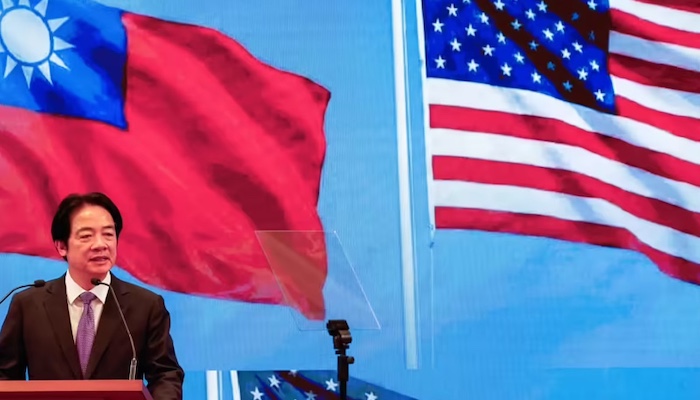
Taiwan said on Saturday that US arms supplies are based on American law and are crucial in deterring rising military threats across the Indo Pacific, especially from China.
Although there are no official diplomatic relations, the United States is still Taiwan’s strongest international ally and is obligated under the Taiwan Relations Act to supply the island with defensive arms.
Trump’s remarks came after a summit with Chinese President Xi Jinping in Beijing on Friday, where he said he had not made a decision on a proposed new arms sale to Taiwan, raising fresh questions about Washington’s commitment to Taipei.
In response, Taiwan President Lai Ching-te’s spokesperson, Karen Kuo, said China’s expanding military activities remain the “sole destabilising factor” in the Taiwan Strait and wider Indo Pacific region.
“Military sales between Taiwan and the US are not only a reflection of the US security commitment to Taiwan as stipulated in the Taiwan Relations Act, but also serve as a mutual deterrence against regional threats,” Kuo said.
She added that Taiwan appreciated Trump’s longstanding support for peace and stability in the Taiwan Strait and would continue strengthening cooperation with Washington.
The Trump administration approved an $11 billion arms package for Taiwan in December. Reports indicate a second package worth about $14 billion is still awaiting presidential approval.
Speaking in Taipei on Saturday, Taiwan Deputy Foreign Minister Chen Ming-chi declined to comment directly on the pending deal because it has not yet been officially announced. He said Taipei would continue engaging with Washington to better understand the US position.
Taiwan’s efforts to increase defence spending have faced resistance from the opposition-controlled parliament. Earlier this month, lawmakers approved roughly two-thirds of the government’s proposed $40 billion defence budget, specifying that the funds be directed toward US weapons purchases.
Lawmakers in both major US political parties have called on the Trump administration to maintain military support for Taiwan amid rising tensions with Beijing.
Kuo Yu-ren, vice president of Taiwan’s Institute for Policy Research, suggested Trump may delay approval of the package until after a planned visit by Xi Jinping to the United States later this year.
During comments following his summit with Xi, Trump also hinted at possible discussions with President Lai regarding the proposed sale, saying, “I have to speak to the person … that’s running Taiwan.”
Asked whether such talks were likely, Deputy Foreign Minister Chen said Taiwan was still trying to understand the “true intent” behind Trump’s remarks.
China, which claims Taiwan as part of its territory, has repeatedly warned against foreign military support for the island and has not ruled out the use of force to bring Taiwan under Beijing’s control.
Taiwan’s government maintains that the island, formally known as the Republic of China, is already a sovereign and independent democratic state.
“This is self-evident and Beijing’s claims are therefore without merit,” Kuo said.
China’s military activity around Taiwan continued throughout Trump’s visit to Beijing, with Chinese warships and aircraft operating near the island on a near-daily basis.
Shen Yu-chung, deputy minister at Taiwan’s Mainland Affairs Council, said Beijing has consistently relied on military pressure and political coercion in its approach toward Taiwan.
“That has always been the basic tone of its Taiwan policy,” Shen said.
Goodness Anunobi