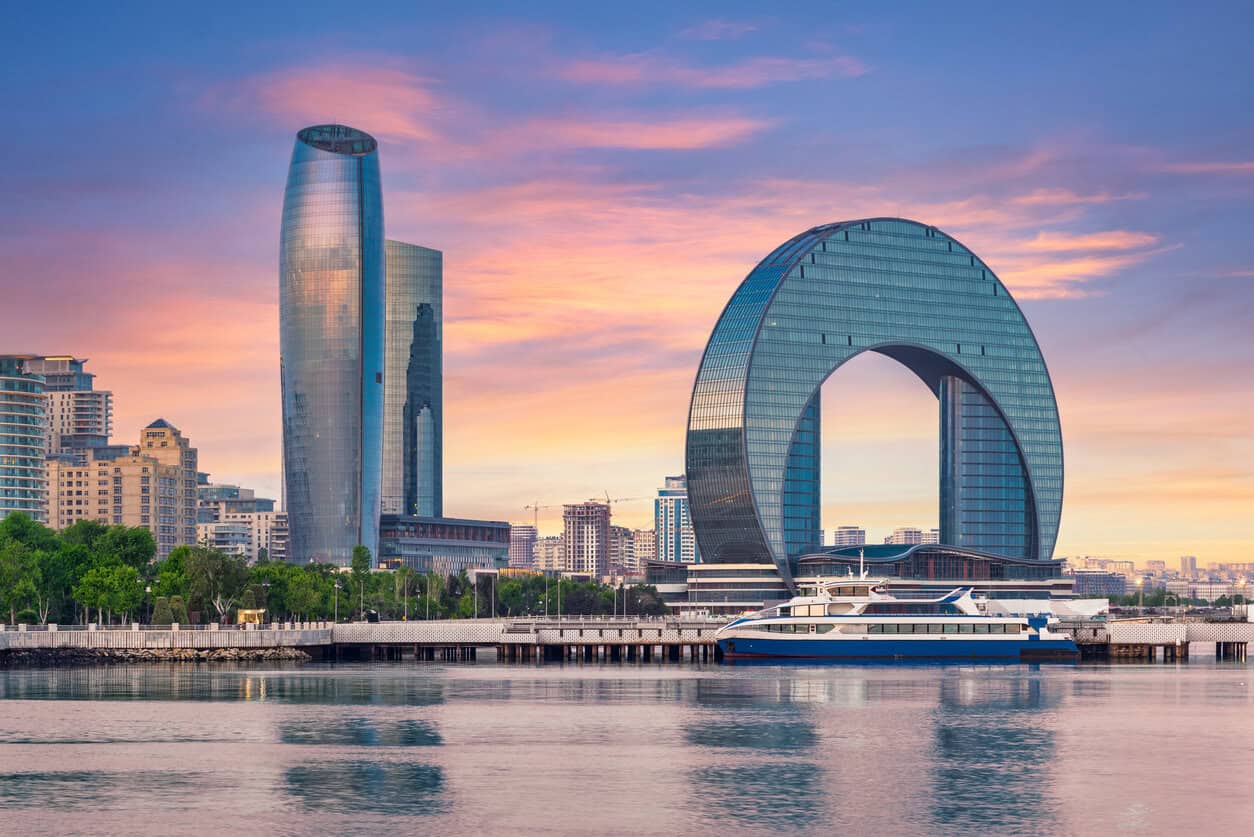
The Crescent Development Project in Baku, Azerbaijan, features a unique circular building at sunset, with a ferry docked in the foreground
Ahead of this weekend’s World Urban Forum (WUF13) in Baku, Azerbaijan President Ilham Aliyev has signed a decree declaring 2026 the Year of Urban Planning and Architecture.
Minister of Human Settlements Thembi Simelane hopes the South African delegation abroad can help find lasting solutions to the world housing crises.
Simelane leads SA delegation to Baku
WUF13, which takes place from Sunday until 22 May, convenes under the theme, “Housing the world: Safe and resilient cities and communities” and seeks to raise awareness of sustainable urbanisation among stakeholders and constituencies, including the public.
It also aims to improve collective knowledge on sustainable urban development through open and inclusive debate, exchange of best practices and policies and sharing of lessons learnt; and promote collaboration and cooperation between different stakeholders and constituencies engaged in the advancement and implementation of sustainable urbanisation.
According to the department of human settlements: “South Africa is rapidly urbanising. At the time the New Urban Agenda was adopted, South Africa was over 60% urbanised; recent data shows this has grown to 68.82% and it is projected to reach 71.3% by 2030.”
SA rapidly urbanising
It added: “Urbanisation is undeniably an irreversible trend. Notwithstanding the opportunities it has presented for urban development in the country, urbanisation has, however, contributed to persistent spatial inequality, challenges in basic services delivery, infrastructure backlogs, and overburdened municipalities.”
The department said: “Informal practices in land use, housing and livelihoods pose significant developmental, policy and management challenges within our urban spaces.
“These issues highlight the dynamic nature of urbanisation and the limitations of current planning and service delivery systems.
“Accordingly, WUF13 will explore how housing can advance inclusion, equity and resilience.”
Infrastructure backlogs
- 2.8 billion people lack adequate housing;
- 1.1 billion people live in slums;
- Failing to transform informal settlements and slums is not an option;
- With nearly 70% of the global population expected to live in urban areas by 2050, cities are growing faster than ever. This growth brings enormous potential for prosperity, innovation and development, but also challenges, particularly in housing, infrastructure, climate resilience and social inclusion;
- Housing is more than shelter. It underpins dignity, well-being, economic opportunity and resilience; and
- It also shapes patterns of energy use, mobility and environmental impact. With nearly 40% of global carbon emissions linked to buildings and construction, the housing sector is central to climate mitigation and adaptation.