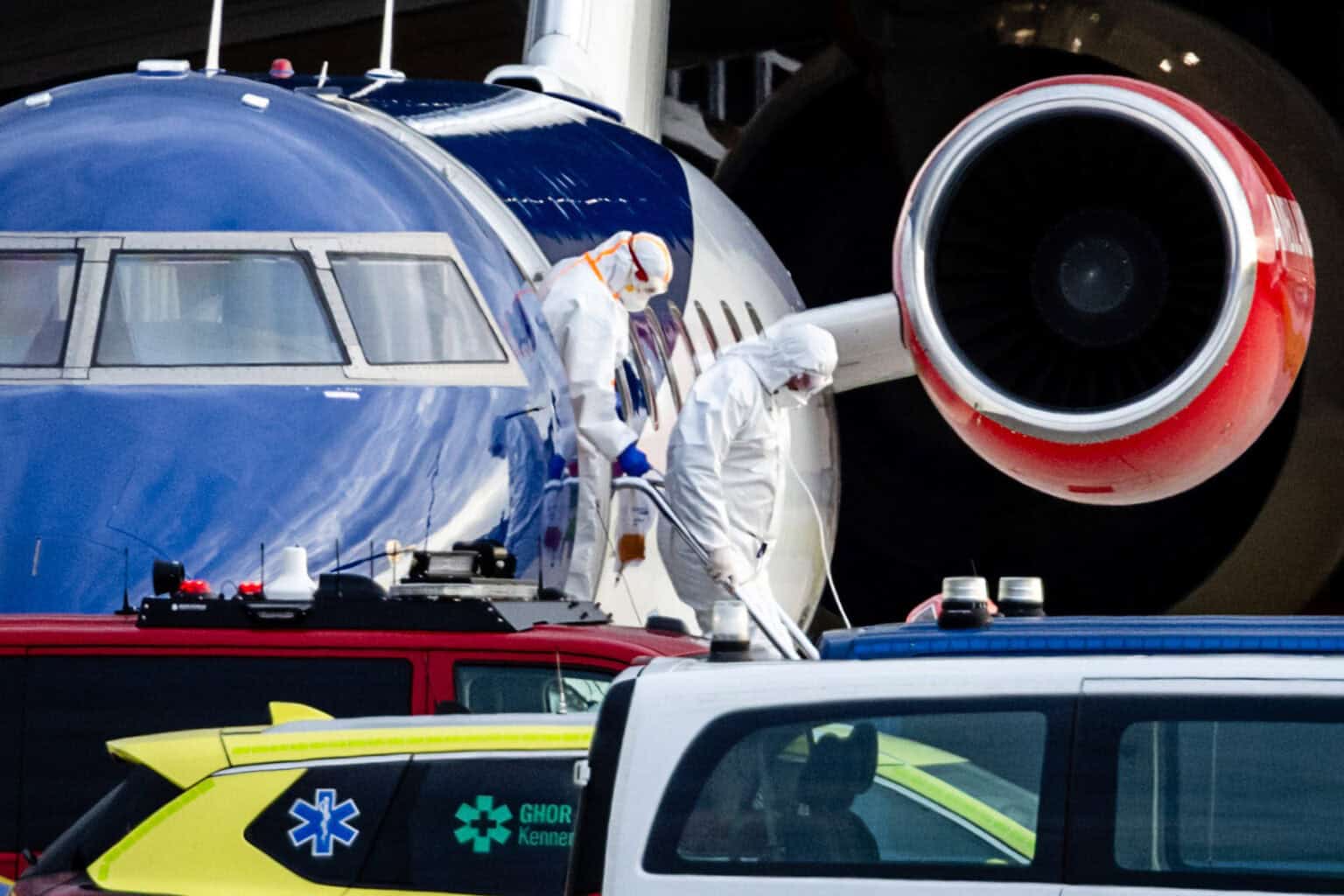
This photograph shows a view of two people in hazmat suits descending from a Bombardier Challenger 605 medical plane allegedly carrying some of the passengers from the cruise ship MV Hondius believed to be infected with hantavirus at Schiphol Airport in Amsterdam on May 6, 2026. A plane that left Cape Verde following the evacuation of a cruise ship hit by the hantavirus landed in Spain's Canary Islands on May 6, while a second flight headed for the Netherlands. (Photo by Jeffrey Groeneweg / ANP / AFP) / Netherlands OUT
Spanish interior ministry sources have reportedly confirmed that a South African woman who was on the same plane as an infected hantavirus passenger, who later died, is back in SA.
The World Health Organisation (WHO) earlier this week confirmed three people had died and three others were ill after several cruise passengers crossing the Atlantic Ocean were found to have a hantavirus strain that can transmit from person to person, the Andes virus.
“While the ship was travelling past South African shores, some of the passengers experienced serious health complications arising from what was initially considered severe acute respiratory infections,” the South African department of Health said.
One of those who was transported from the ship later died, and those she may have come into contact with are now being traced and monitored.
The Citizen on Friday detailed how the woman was on an Airlink flight from St Helena to Johannesburg on 25 April, and later that day boarded a KLM flight to Amsterdam at OR Tambo International Airport. She was removed from the plane and taken to a nearby hospital, where she died.
While a flight attendant who came into contact with the woman, and who showed symptoms, has tested negative for the virus, a Spanish woman is currently under quarantine.
According to sources speaking to AFP, a South African woman who was also on the plane and had been monitored by Spanish authorities “is currently asymptomatic in South Africa after staying in Barcelona for a week before returning to her country”.
What about those on the Airlink flight?
The Citizen reported that Airlink crew members, engineers and other personnel were ordered to stay home after coming into direct contact with the woman.
82 passengers and six crew members were onboard the flight.
According to Airlink flight and airline chief executive de Villiers Engelbrecht, the airline was only informed of the possible dangers of the virus spread on Sunday and was working with authorities to trace all potentially affected passengers.
Due to aircraft rotation, the same aircraft can disembark passengers and shortly afterwards continue operating to another destination. An eight-day delay in notifying an airline could prove problematic from a contact-tracing perspective.
Eight day delay
Medical practitioner Juandre van den Berg said the delays were concerning.
“Eight days is a bit long. Something so severe, like a patient dying from a mysterious illness, is reason enough to step back and say we cannot continue business as usual until things are sorted out,” she said.
WHO head to oversee hantavirus ship evacuation
WHO chief Tedros Adhanom Ghebreyesus will accompany Spain’s health and interior ministers when they coordinate the evacuation of passengers and crew from the infected ship over the next few days.
Spanish authorities have said the ship will anchor off Tenerife on Sunday and will not be allowed to dock. Passengers will be transferred to shore on a smaller vessel, then by bus to the airport. The evacuation must happen between Sunday and Monday due to likely adverse weather conditions. The United States said it was arranging an evacuation flight for Americans on the ship, who would then be taken to a quarantine facility in Nebraska.
The WHO said Friday there were six confirmed out of eight suspected cases of the virus so far. There are no suspected cases remaining on the ship.
Spokesman Christian Lindmeier said that, in some cases, even those who have been sharing cabins on the ship don’t seem to both be infected.
“The virus is not that contagious that it easily jumps from person to person,” he said.
While the incident has sparked global concern, the WHO said the risk of spread was low.
“This is a dangerous virus, but only to the person who’s really infected, and the risk to the general population remains absolutely low,” Lindmeier told reporters.
Additional reporting by Hein Kaiser