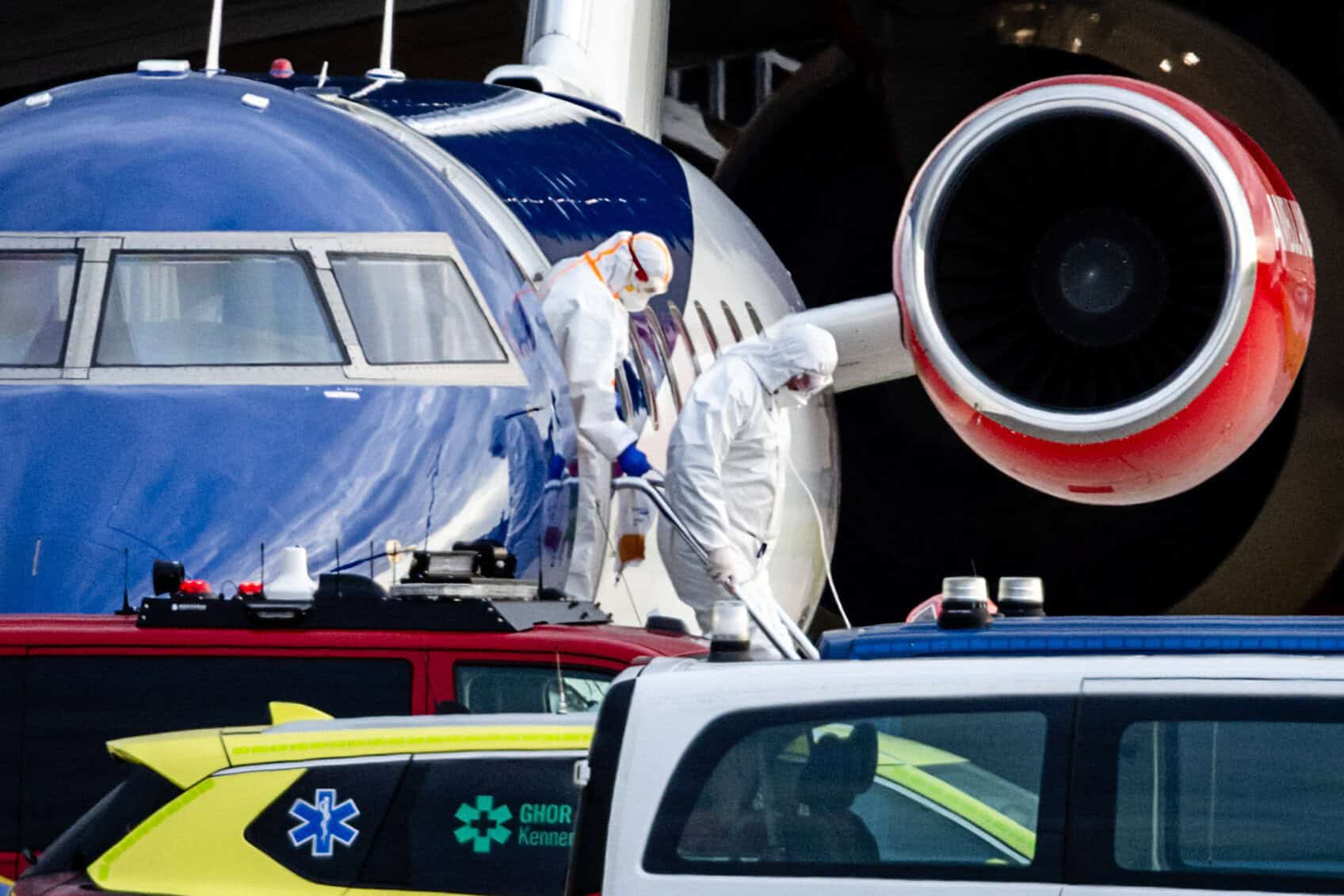
This photograph shows a view of two people in hazmat suits descending from a Bombardier Challenger 605 medical plane allegedly carrying some of the passengers from the cruise ship MV Hondius believed to be infected with hantavirus at Schiphol Airport in Amsterdam on May 6, 2026. A plane that left Cape Verde following the evacuation of a cruise ship hit by the hantavirus landed in Spain's Canary Islands on May 6, while a second flight headed for the Netherlands. (Photo by Jeffrey Groeneweg / ANP / AFP) / Netherlands OUT
Hantavirus has potential been spread further across South Africa, following a delay of eight days in following up on contact tracing of passengers and crew from an Airlink flight from St Helena to Johannesburg which carried a 69-year-old Dutch tourist who later died from the virus in a Joburg hospital.
Several Airlink crew members, engineers and other personnel remain at home and under close medical observation after coming into direct contact with a passenger infected with the Andes strain of hantavirus pulmonary syndrome (HPS), a rare but potentially deadly virus capable of limited human-to-human transmission.
But the airline was only informed of the possible dangers of virus spread on Sunday, according to Airlink flight and airline chief executive de Villiers Engelbrecht.
Woman dies in Joburg hospital after airport collapse
The woman who died was removed from a KLM flight to Amsterdam at OR Tambo International Airport shortly before it was due to take off on 25 April.
The Airlink flight from St Helena arrived earlier that day. She collapsed at the airport and was taken to a nearby hospital where she died.
She became critically ill during her journey home on an Atlantic Ocean cruise ship, MV Hondius, linked to the hantavirus outbreak.
KLM flight crew member hospitalised
A KLM flight attendant in Amsterdam was hospitalised and placed under observation after developing mild symptoms linked to possible exposure.
The crew member had reportedly assisted the same passenger after she became critically ill.
Dutch health ministry spokesperson Mischa Stubenitsky confirmed to international media the crew member had been formally admitted to a specialised hospital ward in Amsterdam to undergo rigorous diagnostic testing.
There were 82 passengers and six crew members onboard the Airlink flight and Engelbrecht said the carrier was presently working with authorities to complete contact-tracing efforts to reach and notify all potentially affected passengers.
‘Eight days is a bit too long’
Medical practitioner Juandre van den Berg said the local timeline was concerning, given the severity of the illness and the uncertainty surrounding the patient’s condition.
“Eight days is a bit long,” Van den Berg said. “Something so severe, like a patient dying from a mysterious illness, is reason enough to step back and say we cannot continue business as usual until things are sorted out.”
Since symptoms initially present similarly to influenza before rapidly accelerating into respiratory distress, Van den Berg said the initial cause for alarm may not have been immediately obvious.
“It starts with acute fever, body aches, lethargy and then respiratory symptoms,” he said.
Van den Berg said the virus itself is relatively fragile outside a host and does not survive for long periods on surfaces.
Mortality rates linked to the Andes strain have reached as high as 50% in parts of Chile and Argentina, according to Van den Berg.
Due to aircraft rotation, meaning the same aircraft can disembark passengers and shortly afterwards continue operating to another destination, an eight-day delay in notifying an airline could prove problematic from a contact-tracing perspective.