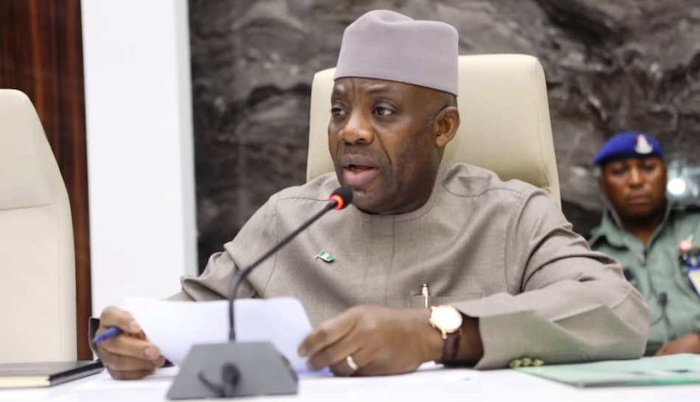
The federal government has committed over N250 billion in interventions aimed at tackling the long-standing student accommodation issues across Nigeria’s tertiary institutions. Minister of Education, Dr Tunji Alausa, disclosed this in Abuja on Wednesday while inaugurating the chairmen and members of Boards of Federal Ministry of Education agencies reappointed chief executive officers, Rectors of Federal Polytechnics, and principal officers of the Federal University of Agriculture and Entrepreneurship, Bama.
Alausa said for the first time in the country’s history, the government was committing such a scale of funding within a single year to expand hostel infrastructure nationwide.
According to him, the intervention, approved by President Bola Tinubu under the Renewed Hope Agenda, will see the construction of new hostels and expansion of existing facilities across federal institutions.
Breaking down the plan, Alausa disclosed that at least 50 tertiary institutions will receive N2 billion each for the construction of student hostels, with every project expected to deliver a minimum of 500 bed spaces.
He said the funds were being channelled through the Tertiary Education Trust Fund (TETFund), which is coordinating the rollout of the projects.
Alausa stated, “We are spending N2 billion each to build hostel accommodation in at least 50 tertiary institutions.
“The N2 billion will deliver 500 bed spaces to each of these institutions. These funds have been mobilised via TETFund.”
He said the government would spend another N80 billion in Public Private Partnerships that would deliver between 1,200 and 1,500 bed spaces in 24 federal tertiary institutions.
“TETFund will come up with one billion in counterpart funding and the rest will come up with three billion. So, total four billion per institution,” he stated.
Speaking on the inauguration of chairmen and members of governing boards of agencies under the Federal Ministry of Education, alongside the appointment and reappointment of key institutional leaders, Alausa emphasised that the ongoing reforms were anchored on expanding access, improving quality, integrating technology, and aligning educational outcomes with national development priorities.
He charged the newly inaugurated board members and institutional heads to provide strategic leadership, ensure accountability, and uphold transparency in the management of public resources.
He also urged them to consolidate existing gains while driving innovation and strengthening the link between policy and implementation across the education sector.
Alausa reaffirmed the federal government’s commitment to repositioning education as the cornerstone of national development, stressing that sustained investment in infrastructure and human capital will be critical to achieving long-term transformation.
He stated, “I urge you to lead with vision, integrity, and an unwavering commitment to excellence.
“Your mandate is clear, build strong academic programmes, invest in faculty development, promote impactful and solution-oriented research, ensure student welfare, and foster strategic partnerships.”
Professor Babatunde Salako was inaugurated as Chairman, Governing Board of National Board for Technical Education (NBTE), while Professor Modupe Adelabu was inaugurated Chairman, Governing Board of National Examinations Council (NECO), and Shofoyeke David was inaugurated as Executive Secretary, National Institute for Educational Planning and Administration.
Also inaugurated were Dr. Bongfa Bonfa as Rector, Federal Polytechnic NYak-Shendam Plateau State; Professor Tijani Kalli as Vice Chancellor of Federal University of Agriculture and Entrepreneurship, Bama; Mr. Abba Kaka Goni as Registrar, Federal University of Agriculture and Entrepreneurship, Bama; and Mrs Aisha Halilu, Librarian, Federal University of Agriculture and Entrepreneurship, Bama.
Mr. Bashir Zubairu was inaugurated Bursar, Federal University of Agriculture and Entrepreneurship, Bama,
while Professor Idris Ali was made chair of the Bosso campus Co-sharing Committee.
Kuni Tyessi