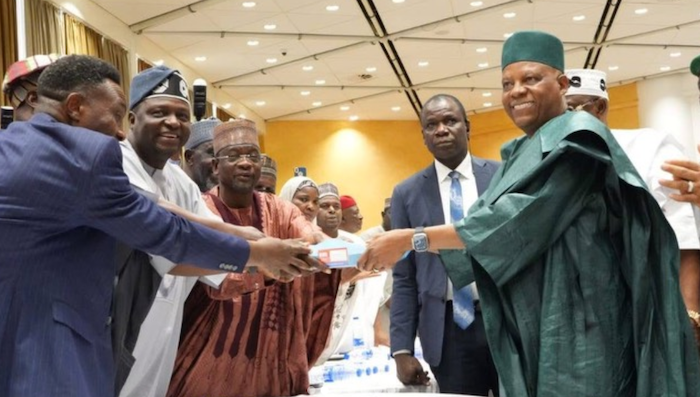
Abuja witnessed a major push for industrial transformation and inclusive financing as stakeholders from Nigeria and India intensified calls for a structured revival of Nigeria’s textile industry and expanded access to funding for women-owned enterprises.
At the Nigeria–India Textile Business-to-Business (B2B) engagement and policy roundtable, leading private sector figures and trade partners outlined a coordinated strategy aimed at repositioning Nigeria’s textile sector as a major driver of jobs, exports, and industrial growth.
The discussions brought together the leadership of the Nigerian business community, represented by the President of the Nigerian Association of Chambers of Commerce, Industry, Mines and Agriculture, Jani Ibrahim, and the President of the Abuja Chamber of Commerce and Industry, Emeka Obegolu, alongside Indian trade representatives and development partners.
In his address, Ibrahim noted that Nigeria’s textile industry remains in steep decline despite strong domestic demand, revealing that the country imported textiles worth over ₦1 trillion in 2025 alone, while exports fell sharply.
A major highlight of the engagement was the proposed industrial partnership with India, which stakeholders described as a model for technology transfer and value chain development.
India was presented as a key partner in machinery supply, textile technology, skills development, and manufacturing investment.
Stakeholders proposed the establishment of textile processing clusters in Nigeria’s cotton-producing regions such as Katsina and Zamfara States, alongside technical collaboration with Indian industrial hubs in Surat, Tiruppur and Coimbatore.
Plans were also discussed for deeper institutional cooperation, including training programmes, virtual trade linkages, and business-to-business matchmaking between Nigerian distributors and Indian manufacturers.
NACCIMA urged a shift from fragmented production to a fully integrated cotton-to-garment value chain covering farming, ginning, spinning, weaving, dyeing, garmenting and retail distribution.
The chamber also identified key bottlenecks including outdated machinery, inadequate skills, weak access to finance, and lack of structured domestic demand for locally made textiles.
In a parallel policy dialogue, the Abuja Chamber of Commerce and Industry also convened a high-level roundtable on mobilising non-interest funding for women-owned businesses, with its President, Emeka Obegolu, SAN, describing financial inclusion as central to Nigeria’s economic future.
Obegolu said women-led MSMEs remain critical to job creation and innovation but continue to face major barriers in accessing credit due to high interest rates, collateral requirements, and rigid lending structures.
He advocated the expansion of non-interest finance models, describing them as ethical, inclusive, and better suited to small and growing enterprises.
He said the Chamber would work with financial institutions, regulators, and development partners to expand awareness, build trust, and connect women entrepreneurs directly to funding opportunities.
Michael Olugbode