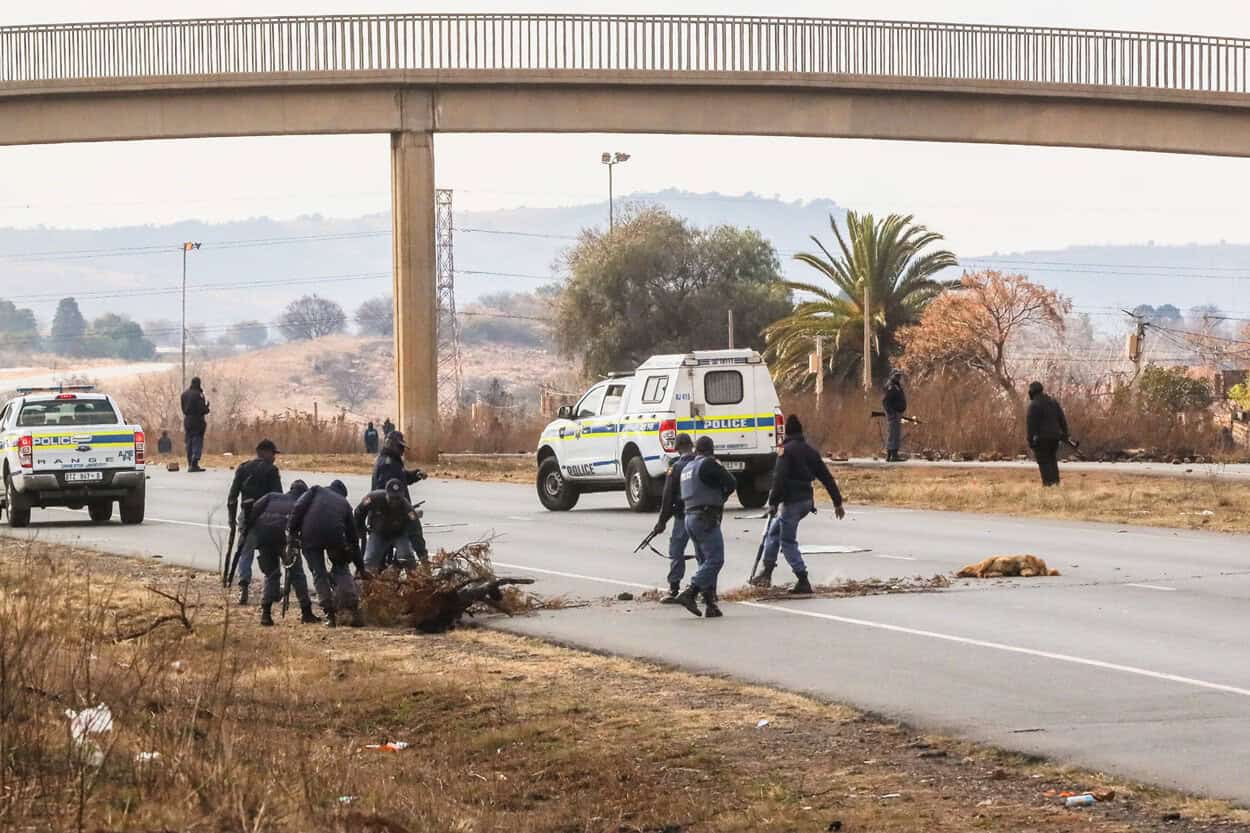
SOWETO, SOUTH AFRICA - AUGUST 03: Police deployed along N12 as Slovo Park residents protest intensify on August 03, 2023 in Soweto, South Africa. According to media reports, the N12 highway near Eldorado Park has been blocked off to traffic for the third day in a row as community members continue protesting over poor service delivery. (Photo by Gallo Images/Fani Mahuntsi)
Since Slovo Park’s establishment south of Eldorado Park in the final years of apartheid, the residents of this informal settlement hoped for dignified development under the new democratic state.
Having received no such thing, they eventually resorted to court action.
It has now been more than a decade since the High Court in Johannesburg ruled that the settlement must benefit from the Upgrading of Informal Settlements Programme (UISP). Yet Slovo Park only has minimal temporary services.
This exemplifies high-level lip service to the UISP, a policy to which the state has allocated generous funds.
There has been ongoing expenditure of public funds on misguided planning and development consultancies that have had no effect on the ground.
At its first hearing into Slovo Park in February last year, the parliamentary portfolio committee on human settlements requested a full account from the City of Joburg of all expenditure on the settlement since 2016. This has still not been produced.
The Slovo Park task team is the vehicle for implementing the 2016 judgment. The Slovo Park Community Development Forum (SPCDF), which has a wide range of portfolios representing different blocks of the settlement attends task team meetings in numbers.
The task team began its work late in 2016. It has held over 40 meetings.
In 2017, the city appointed a consulting firm to guide the establishment of Slovo Park as a township. This firm understood its brief as a conventional housing development and showed no understanding of the inclusive, incremental and participatory upgrading required by the UISP.
The task team spent countless meetings educating the firm and officials on in situ upgrading and explaining why a conventional housing project is unimplementable at Slovo Park.
But the consulting planners pressed ahead, achieved municipal planning approval for their housing plan and were paid their professional fees.
In 2019, the SPCDF, its legal representatives, the Socio-Economic Rights Institute of South Africa (Seri), its technical advisors in the NGO, 1to1, and ourselves at Wits University, succeeded in motivating the city to shelve this plan and start afresh.
Seri, with the support of one of its donors, offered to cover the cost of replanning. But the city set out to appoint and pay a planning consultancy. They, too, understood their brief as planning for a housing development.
Meanwhile, the consultant-driven, erstwhile National Upgrading Support Programme commissioned yet another planning consultant to draw up a layout plan for Slovo Park’s UISP, ignoring layout agreements already made in the task team.
By early 2021, the city had disbanded its tender adjudication panel and was unable to procure consultants. The provincial department of human settlements stepped in and procured the services of yet another town planning firm, with the Gauteng Partnership Fund, as the implementing agent.
Once again, the task team devoted numerous meetings to explaining the kind of planning required under the UISP.
In 2022, the task team, through several workshops, developed a tailored social compact for UISP implementation at Slovo Park and a memo that set out intergovernmental roles and responsibilities. Both documents met political resistance at the time and took more than a year to be signed.
Amid much jubilation, an in situ upgrading plan was officially approved and signed in the Slovo Park hall in May 2023. However, two months later, an official on the task team revealed that Slovo Park was not included in the city’s business plan for UISP implementation.
This caused a breakdown in trust. The SPCDF decided to seek other means to be heard, ultimately appealing to the parliamentary portfolio committee.
By 2025, task team meetings resumed under the oversight of the portfolio committee. The province now handed the task of procuring the remaining planning work back to the city.
The city proceeded to appoint yet another consultant – an architecture firm that would subcontract planning expertise – all overseen by yet another consultant.
In this 10-year period, we have seen politicians undermining willing officials and unwilling officials undermining a willing politician.
Drawing on the Slovo Park task team experience, from 2023 to last year, we made submissions on the draft white paper on human settlements and the city’s draft informal settlement policy. We highlighted the need to invest in in-house expertise and build officials’ experience in championing and implementing in situ upgrading of informal settlements at scale, and end the over-reliance on consultants.
The City of Joburg in its 2025 draft informal settlement policy set out to assign one of its officials the dedicated role of manager: upgrading of informal settlements programme.
However, a consulting firm with a multiyear contract now manages and oversees Johannesburg’s UISP projects and its consultants.
At the most recent task team meeting on 27 April, we found ourselves back to square one.
The consulting firm presented a planning subconsultant’s work towards what is evidently, again, a housing project.
It intends applying beneficiary qualification criteria, showing that the current team of consultants has no understanding of the basic, inclusionary principles of the UISP.
With no-one able to explain the mismatch and duplication, the task team chair is as outraged as the SPCDF, its technical advisors and Seri.
A consulting firm with a multiyear contract to manage the city’s UISP consultants now seems empowered to steer the project against the directive of the high court, the oversight of parliament and the will of an elected political head and the affected community.