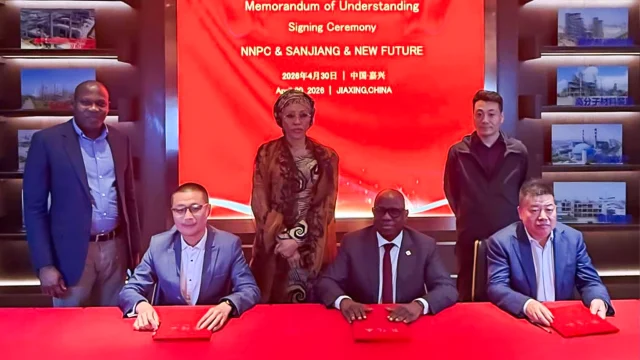
The Nigerian National Petroleum Company Limited (NNPC) has again moved to revive its ailing refineries, announcing Monday the signing of a Memorandum of Understanding (MoU) with two Chinese companies for a potential Technical Equity Partnership (TEP) for the completion and operation of the facilities in Port Harcourt and Warri.
The Chinese firms, a statement from the national oil company disclosed, are: Sanjiang Chemical Company Limited as well as Xingcheng (Fuzhou) Industrial Park Operation and Management Co. Ltd.
The development took place as the NNPC in its Monthly Report Summary for March released Monday said that its revenue during the month rose to N2.77 trillion from N2.68 trillion in February, representing a modest month-on-month increase.
The MoU to revamp the refineries was signed by the Group Chief Executive of the NNPC, Bayo Ojulari; Chairman, Sanjiang Chemical Company, Guan Jianzhong, and Chairman of Xinganchen (Fuzhou) Industrial Park Operation and Management Co. Ltd, Bill Bi, in Jiaxing City, China.
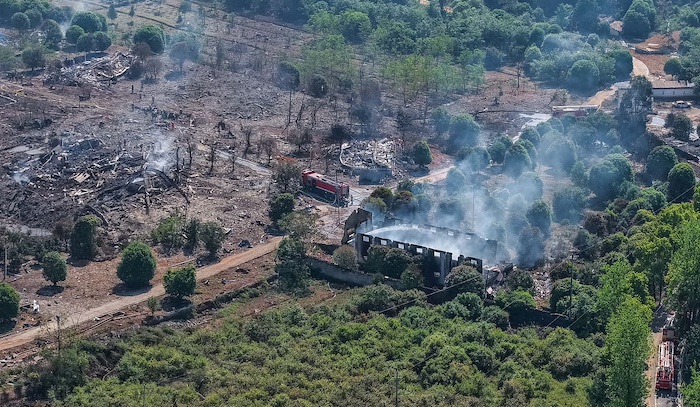
For years, the NNPC has tried to bring the refineries back online, but has failed at every attempt. The last effort before this, which is currently a matter before the Economic and Financial Crimes Commission (EFCC), gulped almost $3 billion.
But the potential framework, according to the NNPC, would cover completion of outstanding work at the two refineries, together with operating and maintaining both facilities to achieve best-in-class, sustainable performance.
Planned expansion and upgrades would elevate both facilities to cleaner, more profitable product standards, it added.
The potential collaboration, it stressed, also contemplates expanding the refineries’ petrochemical capacities and harnessing gas and downstream opportunities through the development of co-located, gas-based industrial hubs.
Speaking shortly after the signing, the GCEO of NNPC, Ojulari, described the MoU execution as a significant milestone, following more than six months of concerted engagement between the technical and management teams of NNPC and the two Chinese partners, Sanjiang and Xinganchen.
“All parties recognise mutually beneficial opportunities for the development and long-term sustainable profitability of NNPC’s refining assets in Nigeria, and the collective weight required for success,” Ojulari noted.
The GCEO further stated that the MoU is an important step on the journey towards identifying potential technical equity partner(s) to restart and expand NNPC’s refineries, and to explore opportunities in co-located petrochemicals and gas-based industries.
The MoU, the NNPC explained, reflects the parties’ shared intent to progress discussions in good faith, with any definitive arrangements to follow in due course and subject to customary approvals.
Meanwhile, the NNPC recorded improved financial and operational performance in March 2026, with revenue rising to N2.77 trillion and profit rebounding, supported by higher crude oil output and increased gas production.
Figures from the company’s March Monthly Report Summary showed that revenue rose from N2.68 trillion in February to N2.77 trillion, representing a modest month-on-month increase and indicating continued stabilisation after the volatility experienced earlier in the year.
Besides, profitability saw a more significant turnaround, with Profit After Tax (PAT) increasing to N276 billion in March from N136 billion recorded in February, when it weakened substantially despite higher revenue.
Crude oil and condensate production averaged 1.56 million barrels per day (bpd) in March, up from 1.51 mbpd in February. The improvement marked a reversal of the 7.9 per cent decline recorded in February, when production was impacted by the outage of the Trans Forcados Pipeline, start-up challenges at the Agbami Gas Turbine facilities, delays at the Sterling Ogualli flow station, and ramp-up constraints at Enyie wells.
A month-by-month trend in the report indicated that production has largely hovered within a narrow range in recent periods, reflecting ongoing operational constraints even as incremental gains are recorded.
Gas production maintained a steady upward trajectory, rising to 7,731 million standard cubic feet per day (mmscfd) in March from 7,458 mmscfd in February. The increase built on earlier growth and reinforced the relative stability of the gas segment compared to crude oil operations.
Statutory remittances to the federation for the first quarter of 2026, according to the NNPC report, was N2.89 trillion. It’s unclear why the NNPC did not treat each month’s remittance separately as it earlier reported payment of N726 billion in January and N1.8 trillion in February.
Operational metrics showed mixed outcomes during the month. Upstream pipeline availability declined sharply to 76 per cent in March from 93 per cent in February, indicating renewed challenges in pipeline integrity and reliability despite earlier improvements.
The Obiafu-Obrikom-Oben (OB3) pipeline maintained 96 per cent completion during the period under consideration, while the Ajaokuta-Kaduna-Kano (AKK) pipeline stood at 93 per cent completion, raising hope of expanded gas transportation in the near future.
NNPC’s retail operations also showed some stability, with petrol availability across its stations remaining broadly consistent following improvements recorded in February.
A note accompanying the report indicated that production improved compared to February, partly due to the early completion of maintenance activities on key assets, including the OML 118 Bonga turnaround maintenance, which was delivered ahead of schedule.
Emmanuel Addeh and Peter Uzoho