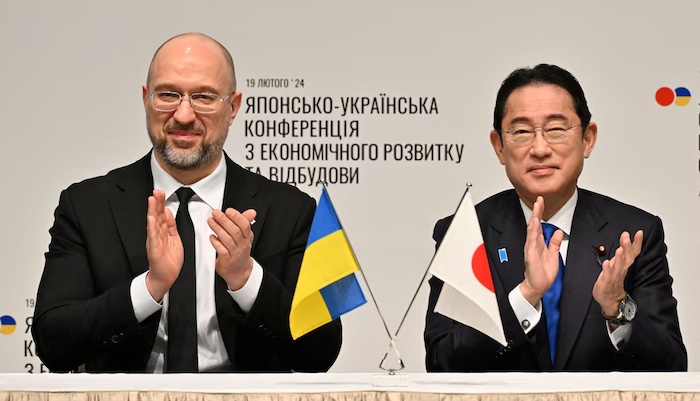
Ukraine says Japan’s decision to ease its weapons export rules could open the door to future talks on military support.
Kyiv’s ambassador to Japan, Yurii Lutovinov, said the change allows discussions that could eventually lead to equipment supply.
“This allows us to talk,” Lutovinov said in an interview. “Theoretically, it’s a very big step forward.”
Japan’s Prime Minister Sanae Takaichi eased export restrictions last week, marking a further move away from the country’s post-war pacifist stance.
The revised rules still limit exports to conflict zones but allow exceptions where Japan’s security interests are involved.
Japan has linked Ukraine’s security to its own, as it faces growing military pressure from China. Its territory lies close to Taiwan, raising concerns in Tokyo about being drawn into a regional conflict.
After Russia launched its invasion of Ukraine in 2022, former Prime Minister Fumio Kishida warned that “Ukraine today could be East Asia tomorrow”.
Lutovinov said Ukraine sees the conflict in broader terms.
“If Ukraine falls, it’s going to be a big domino effect,” he said. “That’s why the Indo-Pacific and the European continent are inseparable from the point of view of our security.”
Japan has not said it will supply arms to Ukraine. Officials from the foreign ministry and the prime minister’s office did not respond to requests for comment.
Takaichi told President Volodymyr Zelenskyy in November that “Japan stands with Ukraine” and supports efforts towards “a just and lasting peace”.
Any transfer of military equipment would require a formal defence agreement. Japan has such arrangements with 18 countries, including Germany, Australia, the Philippines and Vietnam.
Lutovinov said Ukraine is proceeding cautiously because of the sensitivity around defence exports in Japan.
He added that Japan could also support Ukraine by funding the development of air-defence systems to reduce reliance on US-made Patriot missiles.
“We have all necessary industrial capacities for production. But we need investment. We need funds,” he said.
Faridah Abdulkadiri