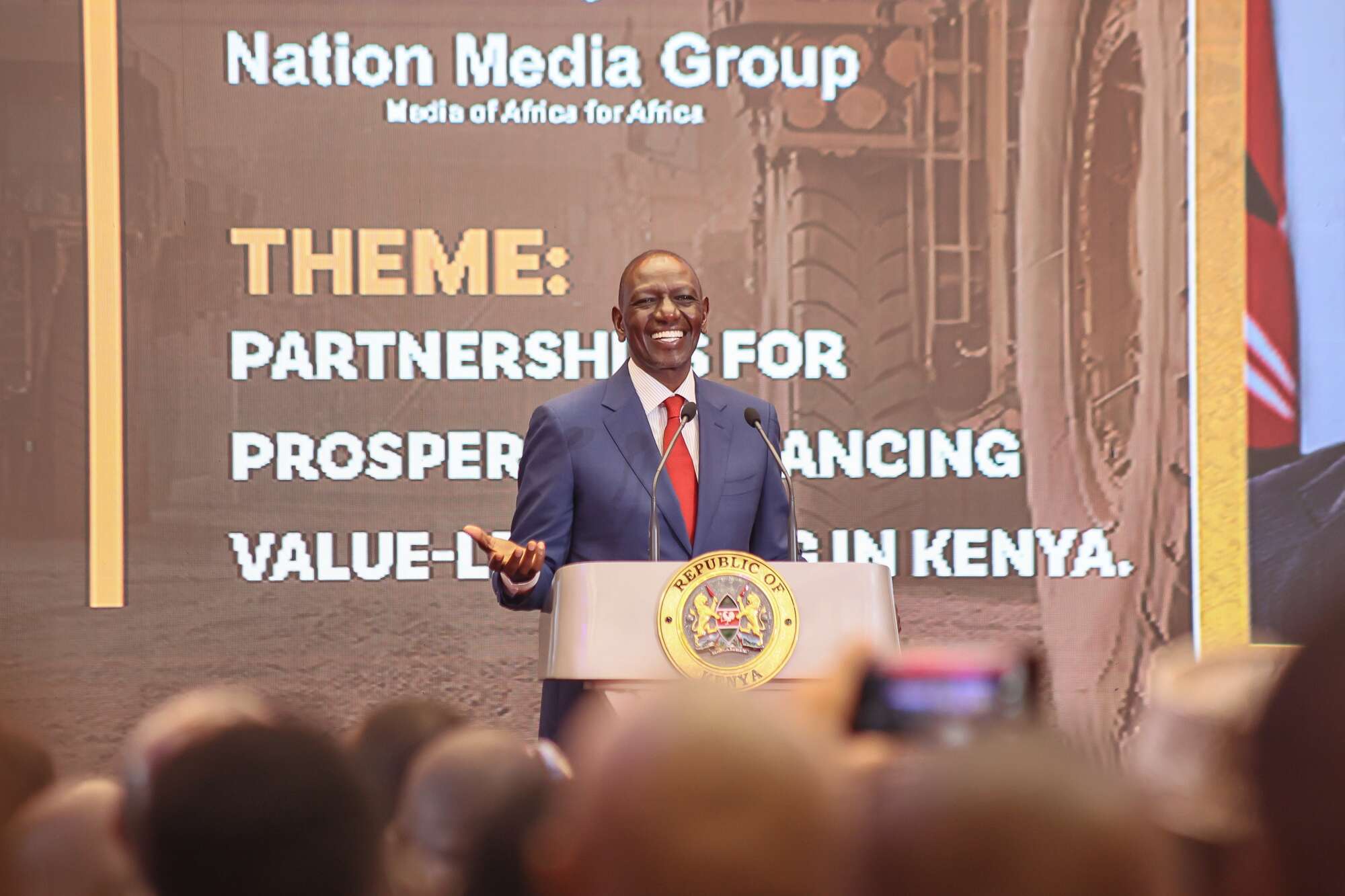
President William Ruto delivers his keynote address during the MICE Kenya Mining Investment Conference and Expo, themed “Partnerships for Prosperity: Advancing Value-Led Mining in Kenya,” at Argyle Grand Hotel, Nairobi Airport along Mombasa Road, Nairobi, on April 28, 2026. Wilfred Nyangaresi | Nation
President William Ruto has moved to clarify his remarks that recently sparked outrage online. The President’s comments about how Nigerians speak English did not go down well with many people.
However, Dr Ruto has insisted that his words were taken out of context and were meant in a light-hearted manner and unifying spirit rather than as criticism.
Speaking during the ‘2026 Mining Investment Conference’ in Nairobi, President Ruto defended himself, saying the intention was to highlight shared fluency in English across Africa.
“The facts are that I was talking about how we, in Africa, speak very good English, all of us,” he said on April 28.
He added that the comments were misrepresented when taken outside that context.
“I was speaking to my fellow citizens somewhere, it was supposed to be a private conversation,” the President explained, “But somebody decided that it should be public and also misrepresented the facts.”
The controversy stems from remarks made during an address to Kenyans living in Italy, April 20, where the President referred to linguistic differences across African countries while speaking about continental identity and communication.
“If you listen to a Nigerian speaking, you do not know what they are saying,” the President said, “You need a translator.”
It was his illustrative comparison about accents that triggered the most reaction online, with many interpreting it as a reference to Nigerian English.
Recognising Nigerians as his ‘in-laws’, the President, however, maintained that the remark was made in jest, stressing that variations in accent across Africa sometimes affect ease of understanding, but do not diminish linguistic competence.
“The facts are that I was talking about how we in Africa speak very good English.” He said, “In fact, in some countries like Nigeria, if you don’t speak excellent English, like what we speak in Kenya, you may need a translator for you to understand the excellent English of Nigeria. So that was the comparison, but somebody decided to take it out of context.”
Nigeria’s Minister of Solid Minerals Development, Henry Alake, who attended the conference in Nairobi, struck a light tone during his address, drawing laughter from delegates in the hall.
“The people of Nigeria have mandated me to inform you and assure you that Nigerians speak good English.” Alake said.
Despite the controversy, delegates and experts within the continent have sought to steer attention back to the substance of the engagement, strengthening African cooperation, advancing investment ties, and promoting shared development goals across the continent.