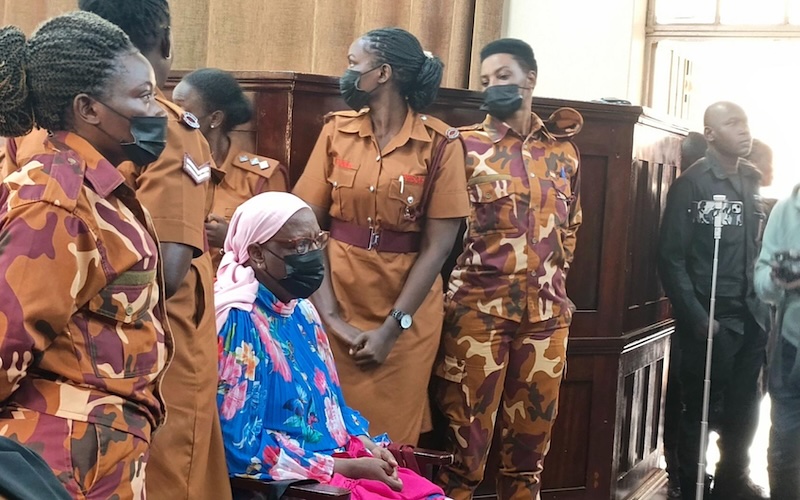
The courtroom atmosphere shifted noticeably as the cross-examination of Molly Katanga entered a more confrontational phase, turning from the facts of the case to the inner workings of family business and control.
By Tuesday, tensions were already running high. What began as a murder trial had, for hours, taken on the texture of a corporate audit. Lawyers leaned into documents, bank statements, and boardroom decisions, probing not just what happened in the wake of Henry Katanga’s death, but who took charge—and how quickly.
At the centre of it all sat Molly Katanga, composed but increasingly pressed. Chief State Attorney Jonathan Muwa-Ganya led the questioning, methodically introducing company records and financial documents.
His aim was clear: to trace how authority within the Katanga family businesses may have shifted after the businessman’s death.
“Can you confirm that these are your bank statements?” he asked at one point, holding up a set of documents. “I can’t confirm because I don’t know if it’s my bank statement or not,” Katanga replied.
It was a response that would come to define much of the exchange. The prosecution’s case suggested that key decisions within the family’s business empire had been made swiftly, perhaps too swiftly, in the days that followed Henry Katanga’s death.
Companies such as Merge Uganda Limited and Max Logistics became focal points, with the court hearing that the couple’s children—Arthur Katanga and Martha Nkwanzi—were later introduced into management roles.
To the prosecution, these developments raised questions about control. To Katanga, they were about survival.
“The business could not be left to drift,” she told the court, her voice steady.
The priority, she explained, had been continuity—keeping operations running for the sake of employees, suppliers, and creditors who depended on the businesses. She maintained that her actions were practical, not opportunistic.
In her telling, there had been no attempt to alter ownership or seize control of the estate. She insisted she had not transferred shares or interfered with the legal structure of the companies.
What she had done, she said, was ensure that day-to-day operations continued in a moment of uncertainty. The prosecution was not convinced.
“Are you aware that dealing with the estate without authorization is an offence called intermeddling?” Muwaganya pressed.
Katanga rejected the implication. Yes, she had been involved in managing the businesses, she said. But that did not amount to unlawful interference with the estate. The questioning soon moved deeper into financial territory.
The state alleged that substantial sums— running into billions of shillings—had been withdrawn from company accounts after Henry Katanga’s death. The suggestion was clear: that control of finances had shifted in a way that warranted scrutiny. Katanga pushed back.
“My late husband never operated those accounts,” she said, explaining that she had long been responsible for managing financial transactions, including debt payments. Her role, she suggested, had not changed with his death—it had simply continued.
“I have been operating these accounts and am still doing the same,” she added, noting that she had maintained access to the accounts even after her arrest, through arrangements with the banks.
But as documents were placed before her, the tone shifted again. Repeatedly, Katanga said she could not recall specific details. At times, she said she could not confirm whether certain records belonged to her.
The exchanges became increasingly tense, with the prosecution suggesting that her inability to remember was not incidental. They argued it was deliberate. Katanga disagreed.
She insisted that any gaps in her recollection were genuine, not an attempt to avoid answering difficult questions. The court then turned to another sensitive issue—documents signed while she was in custody.
The prosecution alleged that Katanga had signed corporate resolutions from Luzira Prison, including decisions that affected company leadership structures. She acknowledged signing some of the documents but said she had not fully understood their legal implications at the time.
In some instances, she admitted, company decisions had not gone through formal meetings, even though official records suggested otherwise.
“I thought that’s how they write those documents,” she said. The response drew immediate pressure.
“You knew it was wrong,” Muwaganya pressed.
Katanga did not accept that characterisation. She told the court she was unaware that such actions could carry legal consequences, including the offence of intermeddling. As the questioning continued, the prosecution introduced another dimension—motive.
Muwaganya suggested that there may have been underlying tensions within the marriage, particularly related to property.
“Our instructions are that you had a deep-seated property wrangle with your late husband,” he said, pressing the point further.
“That you had a motive to eliminate him due to that property dispute.” Katanga’s response was immediate. “That’s not true,” she said.
She denied any such conflict, maintaining that her actions—both personal and financial—had been consistent with her role within the family and its businesses. Yet even as the cross-examination unfolded, another battle was taking shape—this time between the legal teams themselves.
The defence raised strong objections to the admission of certain bank documents, questioning how they had been obtained. Counsel Kabega argued that the evidence had been acquired improperly, after the case had already been committed to the High Court.
“My lord, this is a false affidavit,” he said. “He can’t go to the Magistrate Court when the case is already in High Court, therefore there is no way this evidence can be allowed in this court.”
The challenge struck at the credibility of the prosecution’s evidence. Another defence lawyer, Elison Karuhanga, raised concerns about the role of Vincent Twenomuguni, who was listed as an investigative officer in the documents.
“He wasn’t an investigative officer in this case,” Karuhanga argued. “He lied to the magistrate and these lies are now smuggled into this court.”