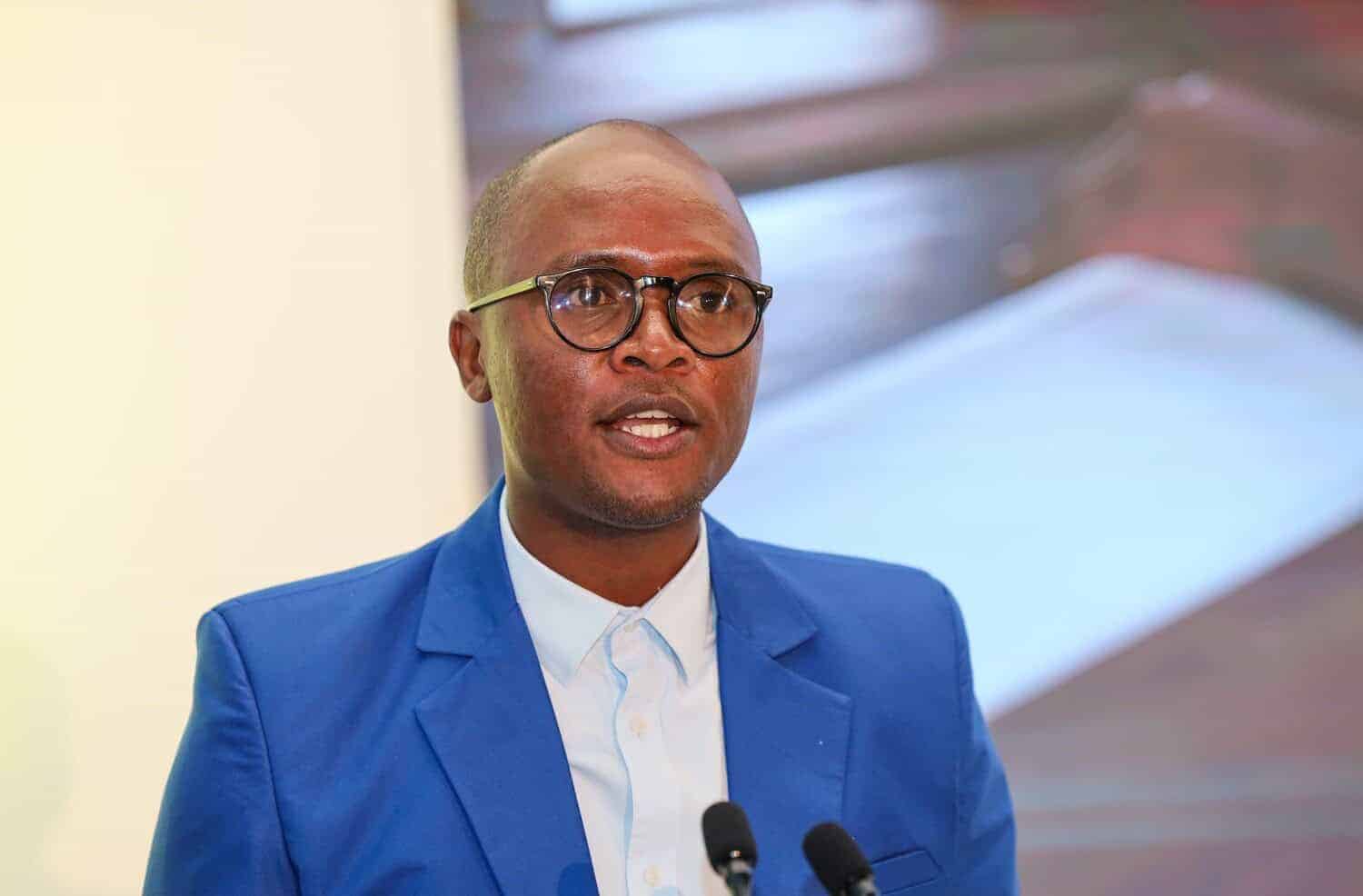
JOHANNESBURG, SOUTH AFRICA - AUGUST 06: Solly Malatsi (Minister of Communications) at the unveiling of Connect Every Child ICT Programme at MTN Innovation Centre on August 06, 2024 in Johannesburg, South Africa. The programme calls on South Africans to join the drive to donate 30 000 devices to bring connectivity and the promise of a brighter future to all children in schools across the country. (Photo by Gallo Images/Luba Lesolle)
Was Starlink and Elon Musk offered the opportunity to pursue a BEE equivalent through training South Africans, rather than selling equity?
Specifically, this refers to the Equity Equivalent Investment Programme (EEIP) for multinationals, alongside heavily weighted Skills Development and Enterprise Development targets for local companies.
Not through the minister
EEIPs allow foreign firms to gain ownership points by investing in training, skills development, and the local industry instead of selling shares.
Minister of Communications and Digital Technologies Solly Malatsi says it is “impossible” for him to offer an EEIP to a multinational company as eligibility is determined by national legislation and regulations.
South Africa’s ICT sector is caught in a regulatory bind that has left global players like Starlink unable to pursue empowerment through the EEIP Programme.
B-BBEE
The EEIP programme is a Broad-Based Black Economic Empowerment (B-BBEE) initiative designed specifically for multinational companies that cannot comply with the standard 25% black ownership requirement due to global policies.
They allow foreign firms to earn empowerment points by investing in training, skills development, and local enterprise rather than selling equity. But in telecommunications licensing, ICASA’s rules shut that door, disadvantaging companies like Starlink.
Talks on launching Starlink in South Africa stalled last year after South African-born SpaceX and Tesla boss Elon Musk and US President Donald Trump ramped up public rhetoric against policies such as BEE laws, which mandate that foreign-owned telecoms companies allocate at least 30% of local equity to historically disadvantaged groups.
Offering EEIP’s
Responding to questions from The Citizen about whether Musk and Starlink were offered an EEIP option, Malatsi stressed: “It is legally impossible for the ministry to offer EEIPs to multinationals”.
“The Independent Communications Authority of South Africa is an independent regulator and has the sole authority to grant individual licences. I can, by law, never be involved in decisions about individual licences, and only have policy-making authority.”
ICASA regulations
Malatsi added: “Currently, ICASA’s Regulations in respect of the Limitations of Control and Equity Ownership by Historically Disadvantaged Groups (HDG) and the application of the ICT Sector Code only recognises ownership to be held by persons from historically disadvantaged groups as a valid measurement of broad-based black economic empowerment in the case of individual licences.”
This is despite the BBBEE Act and the ICT Sector Code (approved by the Department of Trade and Industry in 2016) acknowledging that empowerment can happen in different ways, including through EEIPs.
Policy direction
It is this “misalignment” that prompted Malatsi to issue a Policy Direction in May 2025, urging ICASA to consider revising its ownership regulations.
He said: “I am not changing the rules nor instructing ICASA to give any individual company a licence. I am merely telling ICASA to consider reviewing its ownership regulations so that they can be aligned with the BBBEE Act and the ICT Sector Code. ICASA has not changed its ownership regulations.”
The directive came two days after President Cyril Ramaphosa met US President Donald Trump in Washington to “reset” strained relations following false claims of “white genocide” and attacks against Afrikaner farmers in South Africa – a statement also made by Musk, who attended the Oval Office meeting.
Not about Starlink
Malatsi insisted the move was not about Starlink.
“My intention to improve South Africa’s investment environment was first communicated on the 4th of October, 2024, more than 7 months prior to the President’s visit to the White House. The Policy Direction is not, and has never been, about any individual company.
“It is about harmonising the regulatory environment and increasing investment and competition in the ICT sector, so that South Africans consumers have more choice and better access to connectivity,” he said.
Licence
Last year, ICASA chairperson Mothibi Ramusi confirmed the authority had not received a formal licence application from Starlink
“We indicated previously that Starlink does not hold any licence issued by the authority to provide electronic communications, electronic communications network or broadcasting services in South Africa.”
‘Mixed tech’
Malatsi did not elaborate on Musk’s satellite service, telling The Citizen at the Africa Tech Festival in Cape Town last year that getting South Africa connected requires a “mixed tech” approach
“Whether it be fibre, through broadband connectivity, or the current debate that is everywhere else in the world about how low-orbit satellites can play a role in this space that we are in.”
Malatsi summoned
The debate around Starlink’s possible exemption from B-BBEE rules intensified when Malatsi was summoned by the portfolio committee on communications and digital technologies.
The committee argued his approach contravened the Electronic Communications Act, which requires licensees to apply B-BBEE.
Several organisations vowed to challenge any plan to allow Starlink to operate outside the policy in court, citing constitutional provisions on equality. Starlink was envisaged to roll out connectivity, particularly in rural areas of South Africa.
Starlink operates thousands of low-earth orbit (LEO) satellites to provide high-speed internet globally.