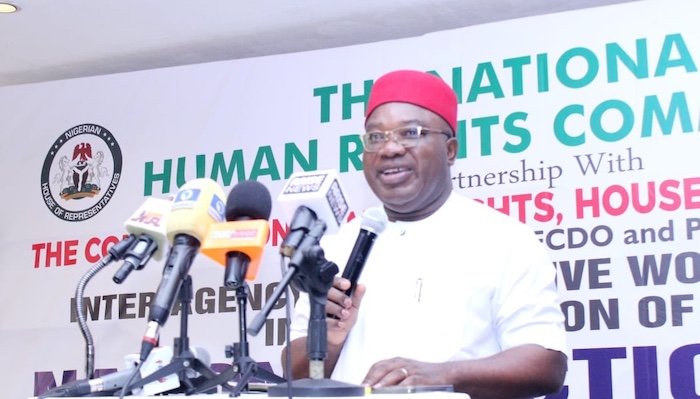
National Human Rights Commission (NHRC) raised the alarm over Nigeria’s worsening security crisis, warning that the country risks entrenching cycles of violence unless the protection of civilians becomes the central objective of all military and security operations.
In a statement, the commission’s Executive Secretary, Tony Ojukwu, extended condolences to the Nigerian Armed Forces and to governments and citizens across heavily affected states.
They included Borno, Niger, Benue, Kaduna, Kwara, Sokoto, and Plateau, where communities suffered devastating attacks in recent weeks.
The commission expressed deep concern over what it described as a dangerous escalation in both the frequency and sophistication of attacks, targeting not only military formations but also civilian spaces, such as markets, worship centres, and public institutions.
Particularly troubling, it stated, were coordinated assaults on military bases in the North-east and suicide bombings in civilian locations, including Maiduguri.
Describing the violence as a “systematic assault” on fundamental human rights, Ojukwu stressed that the attacks violated protections guaranteed under Nigeria’s constitution and international frameworks, such as the African Charter on Human and Peoples’ Rights.
He maintained that deliberate targeting of civilians and security personnel by non-state actors constituted egregious breaches of international humanitarian law.
NHRC warned that the evolving pattern of violence—marked by coordinated raids, suicide bombings, and its spread from the North-east into the North-west and North-central—signalled a more complex and entrenched phase of insecurity requiring urgent recalibration of national strategy.
Deji Elumoye, Michael Olugbode, Sunday Aborisade, Linus Aleke, John Shiklam and Gbenga Sodeinde