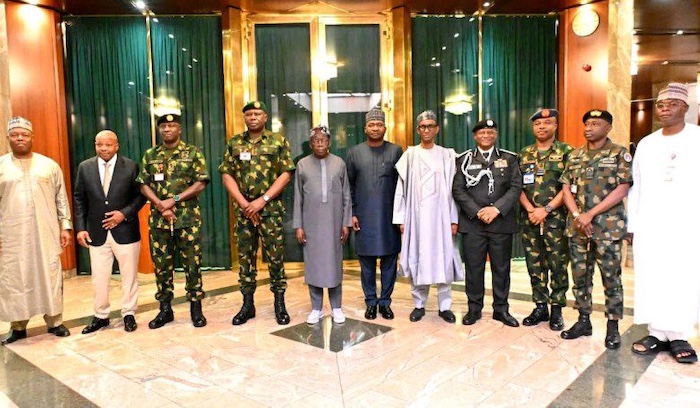
President Bola Ahmed Tinubu, on Monday afternoon, met with the three service chiefs, Chief of Defence Staff (CDS), Inspector-General of Police, and heads of intelligence agencies at State House, Abuja.
The emergency meeting held at the office of the president was convened amid mounting concerns over the country’s security situation, especially recent attacks on military formations in Borno State.
The closed-door session was attended by Chief of Defence Staff, General Olufemi Oluyede; Chief of Army, Lt. Gen Waidi Shaibu; Chief of Naval Staff, Vice Admiral Idi Abbas; and Chief of Air Staff, Air Marshal Sunday Anele.
Equally in attendance were Director-General of Department of State Services (DSS), Oluwatosin Ajayi; Director-General of National Intelligence Agency (NIA), Ambassador Mohammed Mohammed, and Inspector-General of Police, Tunji Disu.
National Security Adviser to the President, Mallam Nuhu Ribadu, was also present alongside other top security officials.
The crucial security meeting took place following a controversial Nigerian Air Force airstrike in Borno State that reportedly killed over 100 civilians.
The strike, which occurred on Saturday at Jilli Market along the Borno-Yobe border, aimed to destroy suspected Boko Haram targets.
While the Nigerian Air Force confirmed carrying out “precision mop-up airstrikes on identified terrorist locations” in the Jilli axis, it did not acknowledge civilian casualties or confirm that a market was hit.
Defending the operation, the presidency stated that the location had been compromised by insurgents.
Senior Special Assistant to the President on Media and Publicity, Tope Ajayi, said the market had become “a legitimate military target” after being turned into a logistics and trading hub by Boko Haram and ISWAP fighters.
On Monday’s meeting was held against the backdrop of recent developments, including a travel advisory issued by United States Department of State, authorising the voluntary departure of non-emergency government personnel and their families from its embassy in Abuja.
The advisory, issued on April 8, cited “deteriorating security situation” and placed 23 of Nigeria’s 36 states under a “Level 4: Do Not Travel” classification, the highest risk category.
States later added to the advisory included Plateau, Jigawa, Kwara, Niger and Taraba.
The US authorities highlighted threats ranging from insurgency in the North-east to banditry in the North-west and North-central, as well as persistent violence in parts of the south and South-east, including the oil-producing regions.
The embassy subsequently suspended visa appointments in Abuja, although its Lagos consulate continued to offer routine and emergency services.
Reacting to the US travel advisory, the federal government described it as a routine precaution based on US internal protocols. The government insisted the advisory did not reflect the broader security reality across the country.
Information and National Orientation minister, Mohammed Idris, said while isolated incidents persist-ed, “There is no general breakdown of law and order, and the vast majority of the country remains stable.”
Buratai: Blow to Terrorists’ Hub
Former Chief of Army Staff (COAS), Lieutenant General Tukur Buratai (Rtd), has described the Jilli Market airstrike as a necessary blow to a terrorist hub in the North-east operational theatre.
Responding to the development, Buratai, in a statement personally signed, commended the troops and the Air Component of Operation Hadin Kai for their professionalism and sacrifices in defence of the country.
He maintained that the strike was a targeted military action based on credible intelligence, indicating that Boko Haram and ISWAP terrorists were using the weekly market at Jilli to collect illegal levies, procure supplies, and plan further attacks.
He said, “I have followed with serious concern reports of the airstrike at Jilli Market along the Borno–Yobe border, where over fifty persons lost their lives, and many others were injured. Any loss of innocent life is deeply unfortunate and painful.
“However, I must state clearly that I commend the Nigerian Air Force and the intelligence community for the courage and professionalism displayed in this operation.”
Buratai said, “The strike was a targeted military action based on credible intelligence that Boko Haram and ISWAP terrorists were using the weekly market at Jilli to collect illegal levies, procure supplies, and plan further attacks.”
He urged the public to understand the history of Jilli Market, stating that it has long served as a notorious terrorist logistics hub.
He said the Nigerian Army had repeatedly raided and shut down the market in the past.
Buratai stated, “In 2018, during Operation Last Hold, our troops occupied the area and engaged in multiple clashes with insurgents. Despite several closures, the terrorists continued to operate the market with the cooperation of some individuals who patronised and supplied them.
“It is deeply regrettable that innocent lives may have been caught in the strike, but the sole responsibility rests with the terrorists who deliberately embed themselves within civilian spaces as human shields.
“No military wishes to harm civilians, but when a market is dominated by terrorist logistics and warnings have been ignored for years, the military has a duty to act. I appeal to the people of Geidam, Gubio, Damasak, and Ngamdu to cooperate with the military.”
He warned communities, “Stop patronising or supplying goods to any market where terrorists establish or frequent. Communities that continue to trade with insurgents will inevitably find themselves in harm’s way.
“The armed forces deserve our support. They acted on solid intelligence and struck a legitimate target. While we mourn innocent lives lost, we must not weaken our resolve against an enemy that shows no mercy.
“Victory is certain with continued military action and civilian cooperation. May the souls of the departed innocent rest in peace, and may the injured recover swiftly.”
Lawan Seeks Independent Probe as Civilian Death Toll Rises
Former President of the Senate and Chairman of Senate Committee on Defence, Ahmad Lawan, called for an immediate and independent investigation in-to the military airstrike in Yobe and Borno states.
In a statement, Lawan expressed sorrow over the incident, which occurred in Jilli Futchimiram, a community in Geidam Local Government Area, where military jets targeting suspected Boko Haram insurgents, allegedly, struck a busy local market.
Lawan said although the military deserved commendation for its sustained efforts in combating insurgency, the scale of civilian casualties in this instance raised serious concerns that must not be ignored.
He stated, “While I fully appreciate the enormous sacrifices of our armed forces and the complexities involved in distinguishing combatants from civilians in conflict zones, the magnitude of this tragedy compels us to ask difficult but necessary questions.”
Lawan stressed that the victims, described largely as innocent civilians at a local market, deserved justice, adding that their families must be given clear answers on how the incident occurred.
The former senate president called on the federal government and the military authorities to ensure transparency by allowing an independent and thorough investigation into the circumstances surrounding the strike.
He also urged authorities to prioritise the welfare of survivors by ensuring prompt medical attention and providing adequate compensation to families of those who lost their lives.
He warned that Nigeria’s fight against terrorism must not come at the cost of civilian lives, urging security agencies to adopt more precise and intelligence-driven strategies in their operations.
“We must never allow the war against terror to desensitise us to the sanctity of innocent human life,” he stated.
Sani Warns Against Politicising Insecurity, Vows to Deal Decisively with Troublemakers
Kaduna State Governor, Senator Uba Sani, warned that his administration will not tolerate the politicisation of insecurity in the state.
Speaking at the State Security Council meeting held at Government House, Kaduna, Sani said any individual or group seeking to undermine peace will face the full weight of the law.
Sani stated that the constitution entrusted him with the responsibility of protecting life and property, stressing that he would continue to discharge that duty “firmly and without compromise.’’
According to the governor, “We are not unaware of those who seek to test our resolve. We are monitoring developments closely, and we are prepared to act. Kaduna State will not return to a past defined by violence, fear, and division.
“That chapter is closed. The whole nation can readily testify that since we assumed office on May 29, 2023, Kaduna State has not witnessed any form of ethno-religious conflict or even farmer-herders conflict.
“We must strengthen intelligence at the grassroots, deepen collaboration with traditional and religious institutions, and maintain seamless coordination among all security agencies. We must stay ahead; consistently and deliberately,’’ he said.
Sani reiterated that the Kaduna Peace Model re-mained central to his administration’s success in addressing insecurity, describing it as “a security approach anchored on inclusivity, intelligence-led operations, inter-agency coordination, and community ownership.’’
He stated that the model had shifted from reactive containment to proactive prevention.
Sani stated, “Our most critical asset remains intelligence. We have strengthened the systems that support timely information gathering and real-time sharing across agencies.
“This has enabled us to detect threats early, disrupt criminal networks, and prevent escalation. Kaduna State is increasingly recognised for this coordinated approach, and while we remain focused on improvement, the results speak clearly.”
The governor, however, cautioned that sustaining progress required vigilance, urging citizens not to rest on their oars.
He said, “The threat landscape is evolving – becoming more complex– and in some instances, influenced by political opportunism.
“As we approach a sensitive political period, we must anticipate attempts to exploit divisions and destabilise communities.”
Deji Elumoye, Michael Olugbode, Sunday Aborisade, Linus Aleke, John Shiklam and Gbenga Sodeinde