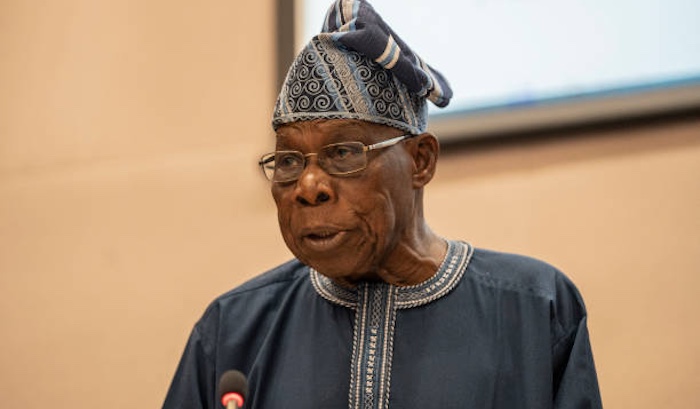
Former President of Nigeria Olusegun Obasanjo speaks speaks at the launch of the AU-LED report on Tigray peace process during the 38th African Union (AU) Summit, at the AU Headquarters in Addis Ababa on February 16, 2025. (Photo by Amanuel Sileshi / AFP) (Photo by AMANUEL SILESHI/AFP via Getty Images)
Former President Olusegun Obasanjo has delivered one of his most far-reaching interventions on Africa’s security crisis, warning that the continent stood at crossroads where failure to act decisively could deepen instability and expose it further to external manipulation.
Speaking at the third Mashariki Cooperation Conference III (MCC III), Obasanjo challenged intelligence chiefs and security leaders to rethink Africa’s security architecture.
He argued that current approaches have failed to respond to rapidly shifting geopolitical realities.
Drawing from over six decades of experience in military service, governance, and conflict mediation, he dismissed the notion that Africa’s conflicts were inevitable, instead attributing them to leadership failures and systemic weaknesses that have allowed both internal fragility and external exploitation to thrive.
Obasanjo situated Africa’s security dilemma within what he described as the breakdown of the global order established after World War II, pointing to the fallout from the Russian invasion of Ukraine and contrasting it with the uneven global response to crises across regions such as Gaza and the Sahel.
This inconsistency, he argued, has eroded trust in international norms and exposed the selective application of the so-called rules-based order, leaving Africa vulnerable in an increasingly competitive and fragmented world.
Against this backdrop, he warned of a renewed geopolitical contest on the continent, describing it as a “new scramble for Africa.”
He cited the growing influence of global powers, including China’s Belt and Road Initiative, as well as the expanding footprint of Russian-linked security actors across fragile regions.
He also referenced the withdrawal of Western forces from parts of the Sahel, which, he noted, has created security vacuums quickly exploited by other actors.
These developments, combined with a surge in terrorism, violent extremism, and a wave of military coups since 2020, have compounded Africa’s security crisis and exposed the fragility of state institutions.
Within this complex environment, Obasanjo advanced a set of five interlocking propositions that together form the backbone of what he described as a new African security architecture.
At the centre of his vision was a decisive shift from regime protection to human-centred security, where the safety, dignity, and well-being of ordinary citizens become the primary measure of success.
He argued that without placing people at the heart of policy, security institutions risked losing legitimacy and effectiveness.
He, however, called for a renewed commitment to continental solidarity, stressing that Africa must move beyond rhetoric to fully operationalise and adequately resource collective security mechanisms such as the African Standby Force and early warning systems.
For Obasanjo, fragmented national responses are no longer sufficient to address transnational threats that move seamlessly across borders.
Michael Olugbode