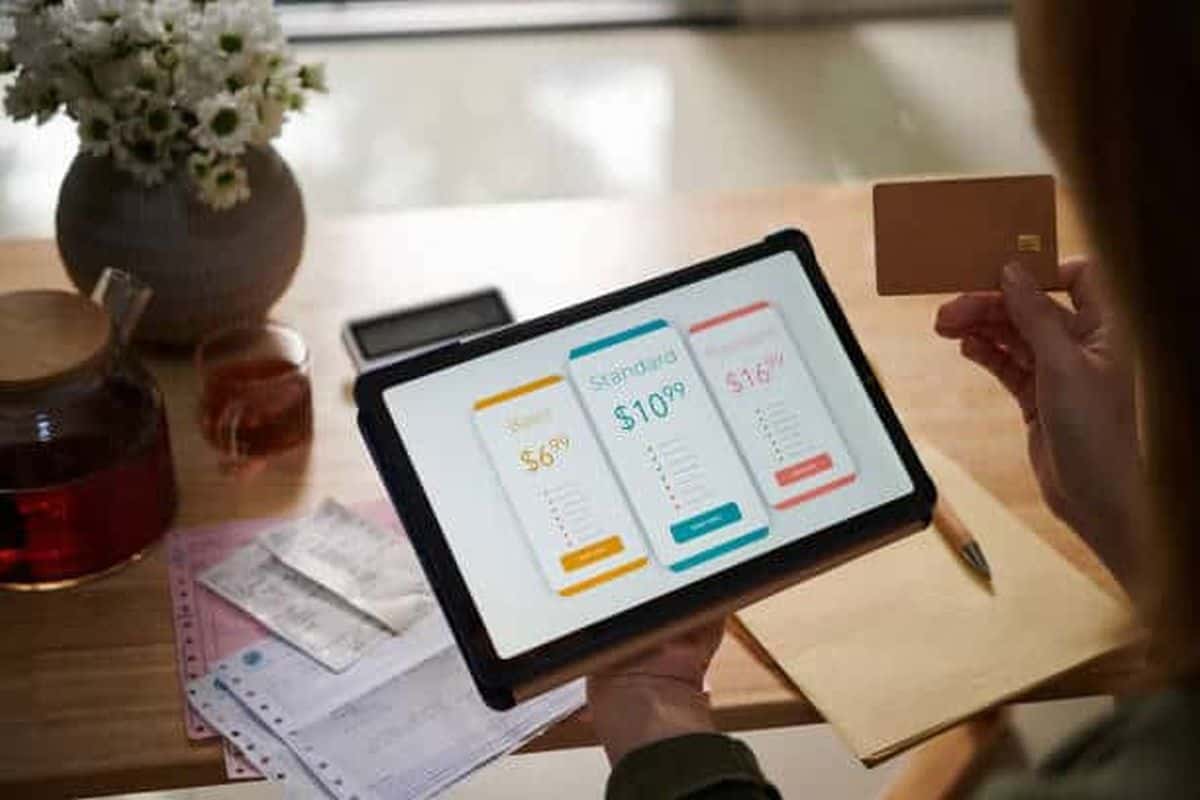
Closeup image of female customer paying for service subscription with credit card
Nothing is for mahala anymore, not even information freely available on the internet.
Websites and apps are now also moving toward subscription payment options, where users are forced to choose between a rock and a hard place. You now have to decide whether it’s worth paying a premium for access to information and platforms.
Johan Steyn, an AI expert and tech commentator, says that paywalls have become more prominent because the traditional revenue stream for media and entertainment companies have dramatically changed after the emergence of social media platforms.
Local students spoke to The Citizen about why they do or don’t opt for subscriptions.
To get a subscription or not?
Robin Kloete, a 19-year-old student from the University of Johannesburg, pays around R110 every month for Apple Music and extra storage on her phone.
“I pay R60 for music and around R50 for storage.
“In purchasing these add-ons for my device, it enhances the experience.”
However, another 19-year-old student, Mckayla Prince, does not have any paid-for subscriptions.
“I feel that having to pay for subscriptions such as Spotify or YouTube Premium, in my eyes, is considered a waste of money. Although many people say that it helps them a lot.”
She admits that there are benefits to having these subscriptions.
“But since I don’t have that much money to pay for them, I don’t see why I would need any of them.”
Why the paywalls?
Steyn suggests that because print media will never fully phase out, advertisers, website designers and app developers have created paywalls to make money from specific features or sources of information.
“And there are some stats that shows that a lot of people are moving back to printed books, printed newspapers.
“But the convenience of reading something on my iPad while I’m in the aircraft and not having to buy it is there as well.
“So, I understand why many websites have a paywall.”
In an attempt to keep up with competition between traditional forms of information and online content, media companies have introduced paywalls to create the illusion of “exclusivity”.
“I think if it’s a source of information that’s important to you and you want to support that institution, and the price is reasonable, it’s maybe a good thing to do.”
Accumulating costs
However, the reality is that these bills accumulate over time, which may pose a financial challenge if not carefully monitored.
Using Kloete’s monthly fees as an example, the total amount on monthly subscriptions is R1 320 every year, which comes on top of other existing expenses.
Steyn says that this can become detrimental towards finances over time.
“The one thing I would normally want to warn people is, if you just do it willy-nilly, before you know it, you suddenly have R10 000 of subscriptions a month,” he says.
“Because a lot of times the actual individual amounts are lower, so it could be $5, around R70/R80, many of us will not even see it on our statement because it’s not significant. But when you start counting it, you realise there are like 20 of them.”
He also recommends downloading tools designed to detect how many subscriptions you have and how much they will cost every month.
Steyn says that there are also customisable settings available on devices and apps, like the Play Store, that allow you to be reminded of subscription payments once the free trial has ended.
Be careful what you pay for
He warns that people should be careful what they pay for because there are potential dangers to subscription paywalls.
“For many, [paying subscriptions is] probably not an issue, but for most of us it is a huge issue.
“You can put [the money spent on subscriptions] in your [mortgage] bond, it will help a lot more.”
Steyn says that there are many free platforms that can be used rather than subscription services.
“I think there’s enough free stuff out there for what most of us need, that you don’t really have to pay for anything, in my opinion.”
Are your details safe?
He says another major problem with paying subscriptions is the protection of your banking details, which can be exposed when being redirected to the app or if there is a breach.
“The biggest question for me is: will you be safe when you submit your credit card details?”
Often people are scammed through redirected adverts and pop-ups that appear while processing payments on websites. However, most sites should redirect you to a trusted paywall.
“A lot of them [apps/sites] will reroute you to an industry-acknowledged payment platform, it could be PayPal or others. Then I will feel a little bit safe.”
Steyn says that before simply complying to payments, you should always ask yourself if the subscription is worth paying and if your details are safe.
“But I don’t know if I just want to add my details to just any random website because, not that I don’t trust them, but what if they have a breach and my credit card details are exposed.”
He also notes that he rarely pays for subscriptions because his private data may be leaked or shared with third parties without his consent.
“So, I pay rarely for online content. But I do have two or three sources that I feel like supporting because I get so much [information/perks] from them.”