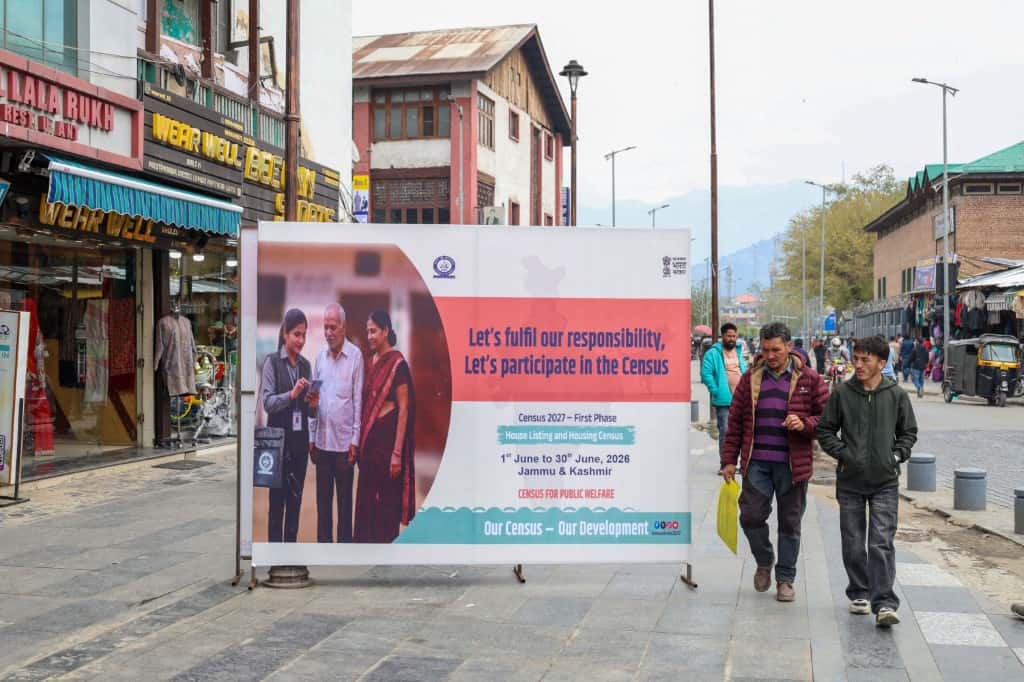
Men walk next to an awareness board for the Census 2027 in Srinagar, Jammu and Kashmir, on April 02, 2026. India has begun counting its population in the world's largest census, which will include caste enumeration for the first time in nearly a century. This year's census is a $1.24 billion exercise during which more than three million Indian officials will spend a year surveying about 1.4 billion Indians regarding their household composition, living conditions, and access to basic amenities. The previous census in 2011 recorded a population of 1.21 billion. It is now estimated to be more than 1.4 billion, making India the most populous nation. (Photo by Firdous Nazir/NurPhoto) (Photo by Firdous Nazir / NurPhoto via AFP)
The world’s largest census, covering more than 1.4 billion people, is currently underway in India. For the first time in a century, it will include the enumeration of caste – a decision that has reignited debate in the world’s most populous democracy about equality, identity, and national cohesion.
The census will span India’s 28 states and eight union territories, covering more than 7 000 towns and about 640 000 villages. In another first, it will be conducted digitally by roughly 30 million enumerators. The exercise will unfold in two phases, with caste enumeration taking place in the second stage.
The caste system, formally outlawed decades ago, historically stratified Hindu society into rigid hierarchies. Those born into the upper castes enjoyed extensive social and material privileges, while lower castes faced entrenched marginalisation. At the bottom of the hierarchy were the Dalits – once labelled “untouchables” – who were subjected to severe discrimination and social exclusion.
India today recognises hundreds of caste groups. Among them are the scheduled castes (SC), historically disadvantaged communities largely drawn from lower castes, and scheduled tribes (ST), marginalised indigenous communities often living in remote rural areas.
Despite legal protections against caste discrimination, caste continues to influence social relations, marriage patterns, and economic opportunity, particularly in rural India.
Supporters of the census argue that updated data is essential, as existing information on caste demographics is outdated and incomplete.
For South Africans, the issue carries echoes of the country’s own past. There are clear parallels between India’s caste hierarchy and the racial stratification enforced under apartheid.
In SA, racial classification determined political, social, and economic status, with whites enjoying the greatest privileges, followed by coloureds and Indians, while black Africans were pushed to the lowest rungs of society.
Policies such as the Bantu Education Act and job reservation ensured their exclusion from meaningful advancement.
Both India and SA attempted to address these historical injustices through state-led corrective policies. India introduced a reservation system that allocates quotas in education, government employment, and political representation to disadvantaged groups.
SA adopted affirmative action and black economic empowerment programmes. While these measures have narrowed inequality gaps to some extent, they remain deeply contested in both countries.
As in SA, where affirmative action is criticised by detractors as “apartheid in reverse”, India’s reservation policies also face opposition. Critics argue that caste-based policies risk entrenching divisions.
This tension lies at the heart of the debate around caste enumeration. Supporters believe that accurate, data-driven insights into socioeconomic disparities will allow the government to design better targeted development programmes.
In their view, detailed data can ensure the benefits of reservations, including access to education and employment opportunities, reach the communities they are intended to uplift.
Advocates also argue that counting caste is an acknowledgement of social reality. Ignoring caste, they say, does not erase discrimination; it merely obscures the structural inequalities that persist in Indian society.
Opponents, however, warn that the exercise risks reinforcing caste identities and undermining national unity. They fear it could fuel divisive “vote-bank politics”, where political parties mobilise support by promising benefits to specific caste groups.
Others caution that once the data becomes public, it may trigger competing demands for expanded quotas from numerous caste communities, further complicating India’s complex reservation framework.
There are also practical concerns that the administrative challenge of identifying and verifying thousands of caste groups could produce inaccurate data.
Indian Prime Minister Narendra Modi and his Bharatiya Janata Party historically opposed caste enumeration, arguing that it could deepen social divisions.
But mounting pressure from campaigners, opposition parties, and leaders within his own party eventually led the government to reverse course and include caste data in the current census.
Under the new framework, enumerators will ask every individual to identify their caste, rather than merely recording whether someone belongs to a scheduled caste or scheduled tribe, as previous censuses did.
Home Affairs Minister Amit Shah described the move as a “historic decision” that underscores India’s commitment to social justice, while opposition leader Rahul Gandhi welcomed it as a “first step towards deep social reform”.
Whether caste enumeration ultimately helps to dismantle inequality, or entrenches identity politics remains to be seen.
What is clear, however, is that India – like SA – continues to grapple with the legacy of historical injustice and the difficult task of balancing redress with national unity.