With a N130tn financing gap looming, policymakers push for structural reforms to make DFIs more investable and boost credit to small businesses……
The Central Bank of Nigeria has signalled plans to drive a sweeping recapitalisation and restructuring of Nigeria’s development finance institutions (DFIs), as part of efforts to tackle the massive funding shortfall facing micro, small, and medium-sized enterprises (MSMEs).
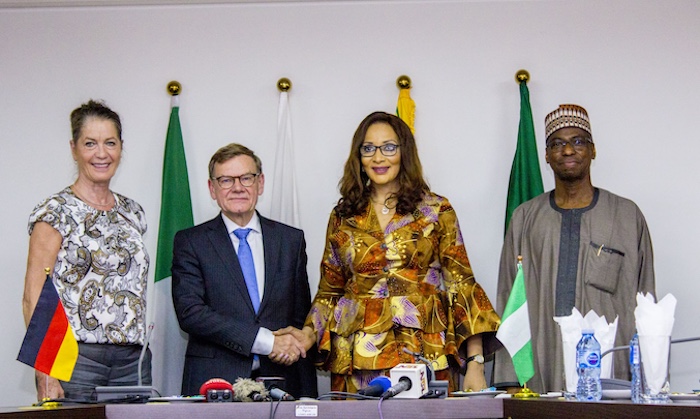
Speaking at the launch of the Nigeria Development Update hosted by the World Bank in Abuja, the CBN’s Deputy Governor for Economic Policy, Muhammad Abdullahi, painted a stark picture of the financing gap.
According to him, the combined asset base of all DFIs in Nigeria stands at just over N8 trillion, far below the estimated N130 trillion required to adequately support MSMEs across the country.
“Across all the DFIs in Nigeria, the total asset base is slightly above N8 trillion, whereas what is required in development finance for MSMEs is over N130 trillion,” he said.
Abdullahi stressed that simply injecting public funds into these institutions would not be sufficient to solve the problem. Instead, he said the focus must shift toward making DFIs more attractive to private capital.
“The only way to address this is not only through public sector capital injections into these institutions, but also by making them bankable and investable,” he added.
To that end, the apex bank is working alongside the Ministry of Finance to review the structure and operations of DFIs, with the goal of improving efficiency, strengthening capital positions, and encouraging a higher appetite for risk in lending.
The reform push will also introduce stronger market-driven principles into the system, a departure from past approaches that, according to Abdullahi, have fallen short of expectations.
“We are looking at the structure to see how more market fundamentals can be incorporated, because the way it has been done in the past has not delivered the desired results,” he noted.
Access to finance has long remained a critical bottleneck for Nigeria’s small business sector. Abdullahi described the challenge as structural, noting that credit flow to the real economy has historically been constrained, leaving many businesses unable to scale or even sustain operations.
He also pointed to recent developments in the banking sector as a potential catalyst for change. With Nigerian banks raising about N4.6 trillion through recapitalisation, he said there is now increased pressure on lenders to deploy those funds profitably, a shift that could translate into more lending to businesses.
“With the N4.6 trillion raised by the banking sector, there are now more funds that must generate returns for investors. We therefore expect increased credit availability going forward,” he said.
However, he cautioned against forcing banks to lend through administrative directives, emphasising the need for proper risk evaluation.
“Banks cannot simply be instructed to lend to particular businesses; they must conduct their own risk assessments,” Abdullahi said.
He expressed optimism that a combination of stronger commercial banks and restructured DFIs would significantly improve access to finance for MSMEs in the near future.
Nigeria’s DFI landscape includes institutions such as the Bank of Agriculture, Bank of Industry, Development Bank of Nigeria, Federal Mortgage Bank of Nigeria, Nigeria Export-Import Bank, Nigerian Consumer Credit Corporation, National Credit Guarantee Company Limited, and The Infrastructure Bank.
If successfully implemented, the proposed reforms could mark a turning point for small businesses unlocking much-needed capital, boosting productivity, and supporting broader economic growth.