Screenshot
Local motorsport governing body, FMU has engaged the Nakawa- based Vocational Training Institute to build an affordable cross car expected to hit the racetrack in the next three months, writes MOSES MUGALU.
In a modest workshop in Nakawa, the future of Ugandan motorsport is quietly taking shape. It is not unfolding under the roar of engines or the glare of floodlights, but through the steady rhythm of welding torches, measuring tools, and determined young hands learning a craft that could redefine an entire sport.
At the centre of this transformation is James Akena, president of the Federation of Motorsport Clubs of Uganda (FMU), whose vision is anchored not in elite competition, but in grassroots access.
His latest initiative, the Cross Car Manufacturing Project, is as much about engineering as it is about opportunity. Developed in partnership with the Fédération Internationale de l’Automobile (FIA), the project seeks to tackle one of Ugandan motorsport’s most persistent barriers: cost.
For decades, the sport has remained largely out of reach for many aspiring drivers, constrained by the high price of imported vehicles, spare parts, and maintenance. The Cross Car concept offers a different pathway.
Designed as lightweight, affordable racing machines, Cross Cars are positioned globally as an entry-level category, now formally recognised within Tier 4 of the FIA’s motorsport pyramid. For Uganda, this classification could be transformative.
“The goal is simple,” Akena emphasises. “We want to make motorsport accessible, practical, and sustainable for Ugandans.”
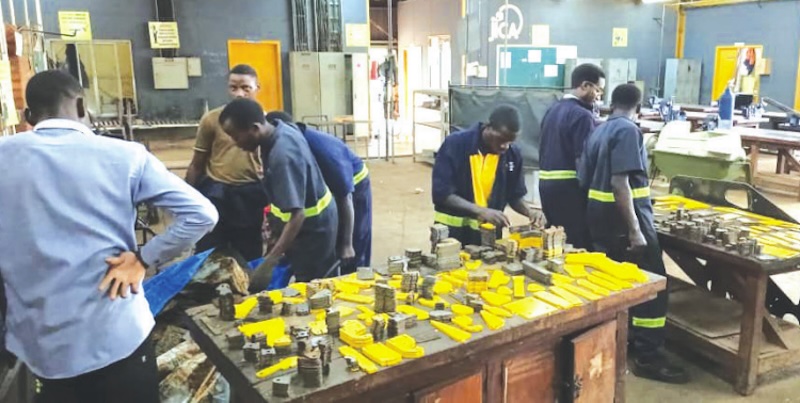
That ambition is already taking shape at the Nakawa Vocational Training Institute, where students are involved in the early stages of production. Their current task— assembling precision jigs—is foundational.
These ensure that every component meets exact specifications, guaranteeing consistency, safety, and compliance with FIA standards. More importantly, the process is equipping students with real-world skills.
This is where the project extends beyond sport. In a country where youth unemployment remains a pressing concern, the initiative doubles as a vocational training platform. Students are gaining hands- on experience in fabrication, welding, electrical systems, and mechanical assembly—skills transferable far beyond the racetrack.
The workshop reflects a deliberate blend of experience and ambition. Seasoned motorsport engineers, mechanics, and technical officials work alongside trainees, guiding them through complex processes while passing on industry knowledge built over years.
IT IS MENTORSHIP IN ITS MOST PRACTICAL FORM
“This structured approach ensures that what is being taught is relevant and sustainable,” Akena notes.
“We are building capacity that will last.” Equally significant is the project’s emphasis on inclusivity.
Motorsport has traditionally been male- dominated, particularly in technical roles. FMU is actively working to change that by encouraging women to participate in areas such as welding, electrical wiring, and quality control.
In the Nakawa workshop, that shift is already visible. Female trainees are taking up tools and responsibilities with confidence, signalling a gradual but meaningful cultural change. The broader implications are substantial.
By localising the production of Cross Cars, Uganda stands to reduce reliance on imported racing machinery, cut participation costs, and stimulate a homegrown motorsport industry. It aligns with wider national priorities around industrialisation, skills development, and innovation.
THERE IS ALSO A PSYCHOLOGICAL SHIFT AT PLAY
For years, motorsport in Uganda has largely revolved around consumption—importing cars, parts, and expertise. This project flips that dynamic, positioning the country as a creator rather than just a participant.
The timeline is ambitious but tangible. FMU expects to have its first locally manufactured, FIA- compliant Cross Car ready for testing within three months. If successful, it will mark a historic milestone— proof that Uganda can design, build, and sustain its own motorsport infrastructure.
According to FMU general secretary Reynolds Kibira, the first cross car could hit the local racetrack in the coming months. He revealed that the estimated production cost stands at about $7,000 (Shs 26 million), with a projected retail price not exceeding $10,000 (Shs 37 million).
This would significantly lower the barrier to entry. Currently, Ugandan competitors pay upwards of Shs 50 million for an imported cross car. Still, challenges remain. Scaling production, maintaining quality standards, and securing consistent funding will require sustained collaboration.
Akena is clear that the project cannot succeed in isolation. He is calling on private sector players, government institutions, and development partners to step in—not just as sponsors, but as stakeholders in a broader vision.
“This is bigger than motorsport,” he says. “It is about youth empowerment, technical education, and national progress.”
Indeed, the Cross Car Manufacturing Project sits at the intersection of sport, education, and economic opportunity. It represents a model where competition becomes a catalyst for skill-building and innovation.
Back in Nakawa, as sparks fly and measurements are checked and rechecked, the significance of the moment may not be immediately obvious. But in those deliberate steps lies the blueprint of something larger—a reimagined motorsport ecosystem built from the ground up.
It is a story not just of a car being assembled, but of a country steadily constructing its own lane on the global racing map.