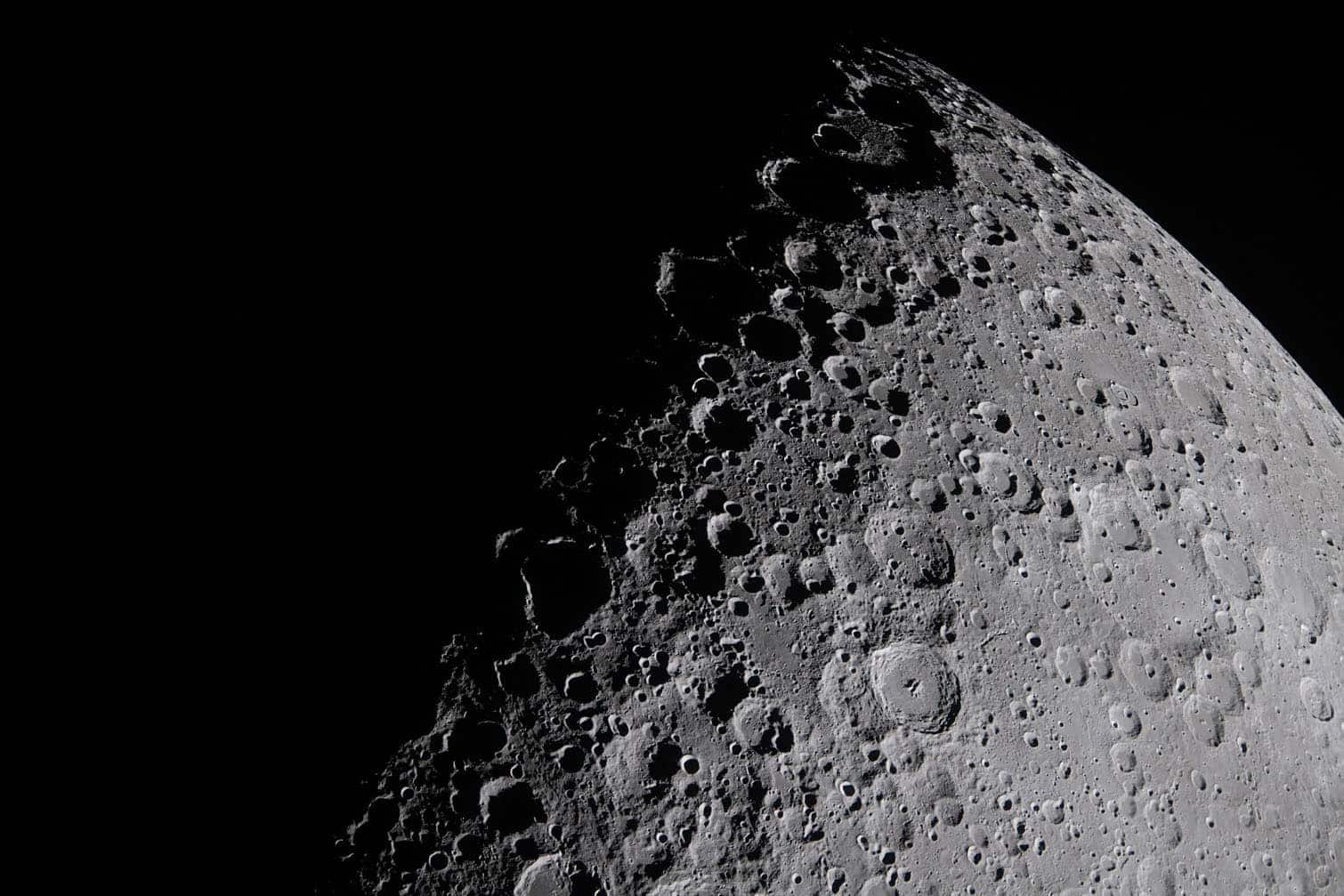
This handout picture released on April 7, 2026, by NASA shows a portion of the Moon coming into view along the terminator – the boundary between lunar day and night – where low-angle sunlight casts long, dramatic shadows across the surface, as seen from the Orion spacecraft on April 6, 2026. The Artemis II astronauts wrapped up their lunar flyby as they continue their journey back to Earth on Tuesday, bringing with them rich celestial observations including little-known lunar craters, a solar eclipse and meteor strikes that scientists hope will open doors. (Photo by Handout / NASA / AFP) / RESTRICTED TO EDITORIAL USE - MANDATORY CREDIT "AFP PHOTO / NASA" - HANDOUT - NO MARKETING NO ADVERTISING CAMPAIGNS - DISTRIBUTED AS A SERVICE TO CLIENTS
This week was, to use the words of Charles Dickens, the best of times and the worst of times for the American people – and how they are perceived by the rest of the world.
While President Donald Trump was threatening to nuke Iran, a voice from space, 400 000km away was saying: “We will always choose earth. We will always choose each other.”
Mission specialist Christina Koch uttered those words shortly after the lunar exploration craft, Artemis II, emerged from the radio silence which cloaked its 40-minute passage around the dark side of the moon.
She said: “Houston, Integrity, comms check. It is so great to hear from earth again.”
“To Asia, Africa, and Oceania, we are looking back at you. We hear you can look up and see the moon right now. We see you, too.”
ALSO READ: Africa eyes lunar race as NASA prepares Artemis II mission to the moon
Her words echoed the global unifying effect of the Apollo missions of the late ’60s and early ’70s, which saw Americans walking on the moon and which did so much to highlight the absurdity of the arms race and the Cold War.
When the crew of Apollo 17 took the now iconic “Blue Marble” colour photo of the Earth in 1972, its astronauts reported that from such a distance, political and geographical boundaries are “meaningless” and “invisible.”
Compared to the Apollo missions, Artemis might seem less significant, yet the four people aboard travelled the furthest (by 6 000km) away from the earth that any human has. And they laid the path for what might well be a permanent human base on the moon in the next five years.
The voyage has inspired children all over the world to follow their science dreams and has proven, once again, that humankind can beat the odds and overcome immense challenges.
That has to be better that blowing other human beings to smithereens, surely?
NOW READ: WATCH LIVE: Artemis II set to shatter Apollo record with historic lunar voyage