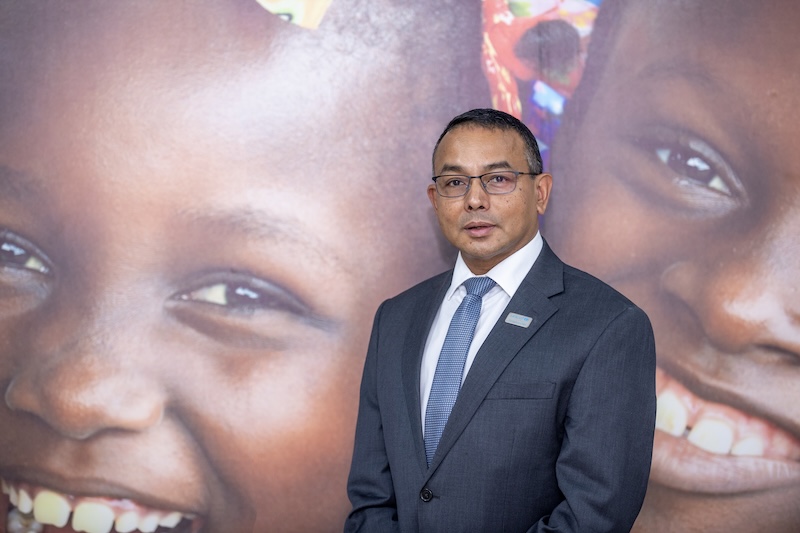
Dr Robin Nandy is the new UNICEF Representative and Head of Office in the Republic of Uganda. He is responsible for directing all of UNICEF’s operations in the country, within a broader United Nations Country team. During 2021-2024, he held a similar role as UNICEF Representative in the Islamic Republic of Iran. Prior to this he served as the Principal Adviser and Chief of Immunizations at UNICEF Headquarters during 2015-2021, directing UNICEF’s global immunization efforts, including the early stages of the COVID-19 vaccine rollout in 2021. Additionally, from 2011 - 2015, he was the Chief of Child Survival and Development in UNICEF Indonesia. Before his position in Indonesia, Dr Nandy led the Global Polio Eradication Initiative at UNICEF Headquarters from 2010-2011 and was the team lead for Health in Emergencies from 2006 - 2011. Dr Nandy is a medical epidemiologist and public health physician with an extensive background international public health, particularly in the areas of child survival, immunization, outbreak response and in multisectoral humanitarian responses. He has worked in several countries affected by conflict and humanitarian emergencies and has participated in several high-profile emergency responses, including, the Kosovo crisis, Hurricane Katrina in the USA, the Indian Ocean Tsunami in Indonesia, the Haiti earthquake, and Cyclone Nargis in Myanmar. Before joining UNICEF, he worked from 2002 - 2006 as a medical epidemiologist at the Global Immunization Division of the US Centers for Disease Control & Prevention (CDC) in Atlanta. From 1998 - 2002 he worked at both the country and headquarters level with the International Rescue Committee (IRC), and for the Indian government in the Republic of Maldives. He also spent four years as a Medical Officer in various hospitals in Delhi, India, from 1990-1994. An Indian national by birth, Dr Nandy obtained his medical degree from Mysore University, India (1990) followed by an MPH at the Nuffield Institute for Health, Leeds, UK (1996). He also an alumni of the Epidemic Intelligence Service (EIS) at the CDC (2002-2004).
In the quiet suburb of Ggaba and the classrooms of Apac, the sanctuary of the schoolhouse has been shattered.
For the parents of Uganda, the events of the past few days have transformed these spaces of growth into sites of unimaginable grief, leaving a nation to grapple with a sudden, localized wave of violence targeting its most vulnerable citizens.
The statistics of the trauma are stark. At the Gaba Early Childhood Development Centre in Kampala, four toddlers, children just beginning to navigate the world, were brutally killed. Farther north, in Apac district, the peace of the Apac Seed Secondary School was broken by a violent assault that left seven students injured.
These aren’t just isolated incidents; they are direct attacks on the fundamental Ugandan belief that a school should be a fortress of safety. Dr Robin Nandy, Unicef Representative to Uganda, expressed a sentiment shared by many across the country: one of profound shock and deep sadness.
Speaking on behalf of the organization, Nandy extended heartfelt condolences to the families in Gaba who have been forced to bury their babies, and offered support to those in Apac whose children are now fighting to recover from both physical wounds and emotional scars.
“Every child in Uganda has the fundamental right to learn, play, and grow in environments that are safe and protective,” Nandy said in an official statement, emphasising that schools and early childhood centres must remain sanctuaries where children thrive rather than places defined by fear.
The recent spate of violence hasn’t just devastated individual families; it has shaken the collective sense of security that binds Ugandan communities together.
“We condemn these attacks on innocent children, which have shaken our collective sense of security and demand urgent action. Schools must never be targets of violence,” he said.
The demand for urgent action is now at the forefront of the national conversation. In the immediate aftermath, Unicef is pivoting to provide psychosocial support for the traumatized children and families who are now navigating a world that feels significantly less safe than it did a week ago.
“Unicef stands ready to support the Government of Uganda, local authorities, and affected communities in providing immediate psychosocial support to traumatized children, families, and school communities,” he said, adding, “We are also committed to working with all partners including the ministry of Education and Sports protection systems and to urgently strengthen child ensure that every child in Uganda can access education in safety and dignity.”
However, the long-term response requires more than just crisis management. There’s a renewed commitment to working alongside the ministry of Education and Sports to overhaul and strengthen child protection systems.
The goal is simple but daunting: to ensure that every child, from the toddlers in Kampala to the teenagers in Apac, can pursue their education in a state of absolute dignity and safety. As the country mourns, the focus turns toward ensuring these tragedies are the last of their kind.