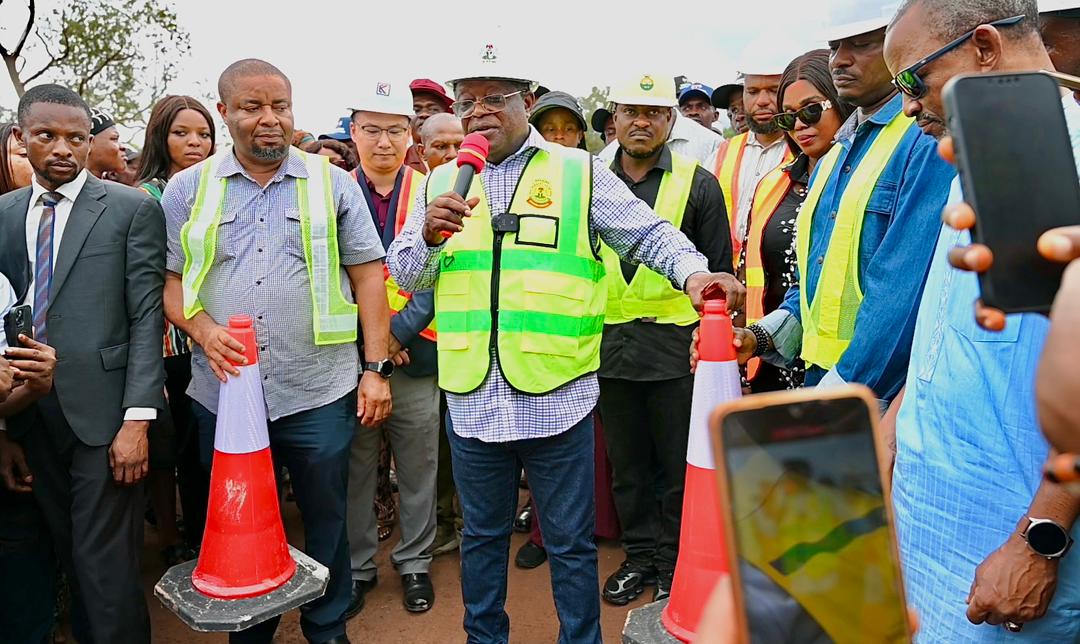
The Honourable Minister of Works Engr. David Umahi,, on Thursday, April 2, 2026, officially commissioned a completed section of the Enugu–Onitsha Expressway, reaffirming the Federal Government’s commitment to improving road infrastructure across the Southeast and Nigeria at large under the leadership of President Bola Ahmed Tinubu, GCFR.
A statement signed by the Senior Special Assistant (Media) to the Honourable Minister of Works,Francis Nwaze, said the Minister while speaking at the event reflected on the previous state of the road and its significance to the region.
“The journey from Enugu to Onitsha used to take about seven hours before 2023. This is the most important road in the Southeast,” he said.
Umahi explained that the project, initially executed under a tax credit arrangement involving MTN Nigeria and handled by RCC, had stalled before the intervention of President Tinubu.
“We inherited this road under MTN’s tax credit scheme, but work had come to a standstill until I appealed to Mr. President,” he stated.
According to him, the President’s intervention not only accelerated construction but also improved the project’s standards.
“The President did not only fast-track the construction; he directed that at least 50 percent of the road should be done in reinforced concrete, similar to the Lagos–Calabar Coastal Highway,” he added.
He noted that although the project had been awarded before the current administration, there had been little progress until it was reviewed and restructured.
“We allowed MTN to continue with their contract sum, excluding 72 kilometres, after a comprehensive review,” he said.
Highlighting the scale of the Federal Government’s commitment, Umahi emphasized:
“It takes courage to do what President Bola Ahmed Tinubu is doing. The entire road is being reconstructed under his leadership.”
Providing updates on the project, he disclosed that the first 50 kilometres of reinforced concrete pavement is about 97 percent completed, with 15 kilometres now opened to ease movement, especially during the Easter period.
The Minister outlined several ongoing and completed road projects across the Southeast, including:
A major connectivity project aimed at linking the Southeast to Abuja in less than four hours, with 123km under construction using reinforced concrete.
The Afikpo–Uturu–Okigwe Road (64km) under the Dangote Tax Credit Scheme.
Aba–Ikot Ekpene Road, with one carriageway completed and the second underway.
Umuahia–Ikot Ekpene Road, nearing completion.
Umuahia–Aba and Owerri–Aba roads, both at advanced stages.
The Second Niger Bridge Bypass (17.5km) with multiple bridges and flyovers.
Enugu–Abakaliki Road and multiple sections of the Enugu–Port Harcourt corridor at various stages of completion.
He also highlighted emergency interventions, including the reconstruction of collapsed bridges at the Artisan area in Enugu within nine months, now equipped with solar lighting.
On the Enugu–Onitsha Expressway, Umahi revealed plans for full solar lighting and landscaping along the corridor.
Beyond infrastructure, the Minister used the occasion to deliver a strong political message, urging the Southeast to adopt a strategic approach ahead of the 2027 general elections.
“In 2027, the people of the Southeast must be strategic. We want these projects completed,” he said.
He called for overwhelming regional support for President Tinubu:
“We should not aim to give him anything less than 80 percent. Do that and leave the rest to us—we will negotiate effectively.”
Umahi also addressed concerns about marginalization, asserting that the narrative is changing.
“The marginalization we talk about is reducing. For the first time, the Southeast holds key national positions, including the Minister of Works,” he noted.
He urged leaders in the region to actively communicate the achievements of the current administration to their constituents.
“Leaders must be vocal about what the President is doing for us. We cannot support him in silence,” he said.
The Minister emphasized the importance of unity and political maturity in the region.
“We must stop attacking one another because of political differences. That is not how to build influence,” he cautioned.
Reiterating the need for long-term strategy, he added: “We supported a Southern presidency in 2023. When it is our turn, others will support us—that is the strategy.”
Commenting on the state of the economy, Umahi acknowledged existing challenges but expressed optimism.
“The President inherited a difficult economy, but the macroeconomic indicators are improving. The worst is over,” he said.
He assured Nigerians that the Federal Government is actively addressing economic pressures and external challenges.
Meanwhile, Umahi concluded by reaffirming the administration’s commitment to infrastructure development and inclusive governance.
“Governance is about development, infrastructure, fairness, and justice. For the first time, the Southeast is not left behind,” he said.
He assured that more projects would be completed and urged continued support for the administration.
“What Mr. President has done is only the beginning—he will do even more,” he assured.