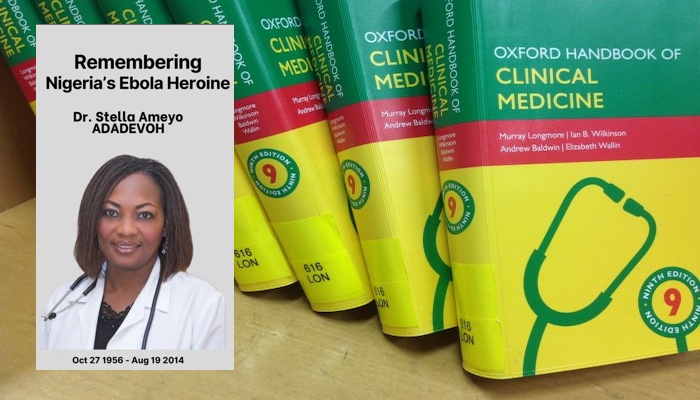
One of the world’s most authoritative medical texts, the Oxford Handbook of Clinical Medicine, has formally recognised Dr Stella Adadevoh for her decisive role in preventing a widespread outbreak of Ebola virus disease in Nigeria, marking a significant moment for the country’s healthcare community.
In its latest edition, the handbook recounted how Adadevoh, during a post-take ward round in Lagos in 2014, identified Nigeria’s index Ebola case despite never having encountered the disease before. Acting swiftly, it said Adadevoh insisted on isolating the patient, resisting mounting pressure and legal threats, in a move that would ultimately halt the virus at its entry point.
Her actions have been widely credited with preventing a major public health crisis in Africa’s most populous country. Nigeria recorded eight Ebola-related deaths, including four healthcare workers, a figure experts say could have been exponentially higher without early containment.
Adadevoh contracted the virus in the process and died on August 19, 2014. Her sacrifice, the handbook noted, reflected a commitment to the “greater public good,” placing the safety of millions above personal risk.
The inclusion of her story in the Oxford Handbook underscored the global relevance of her actions, positioning her as a case study in clinical judgment, ethical responsibility, and crisis response. It also signalled growing recognition of contributions from African medical professionals in shaping global health outcomes.
The handbook stated: “This book chooses to celebrate Dr Ameyo Stella Adadevoh, a Nigerian physician whose diagnostic acumen protected a nation. On a post-take ward round in Lagos in 2014, she recognised the index case of Ebola virus in Nigeria despite never having seen the disease before.
“She isolated and treated the patient des-litigation threats despite neither her hospital nor her country ready to do so and in the face of litigation threats. In order to save others, and for ‘the greater public good’ she sacrificed herself, dying from Ebola on 19 August 2014.
“Thus she protected Nigeria from a death toll far greater than eight (including four other healthcare workers to whom we also pay our deepest respects).
“And so we go forward in the hope that when our own mortality salience is activated and we are not in the warm, comfortable bed of the octogenarian we all desire to become, our existential anxiety can be buffered by the memory of Dr Adadevoh who confers greater meaning to our doctoring lives: we did what we could to help the most.”
Emmanuel Addeh