Lawmakers approve expanded spending plan aimed at clearing legacy debts, funding key infrastructure, and stabilising Nigeria’s fiscal outlook….
Nigeria’s parliament has approved a N68.3 trillion budget for the 2026 fiscal year, marking a significant increase from the initial proposal submitted late last year.
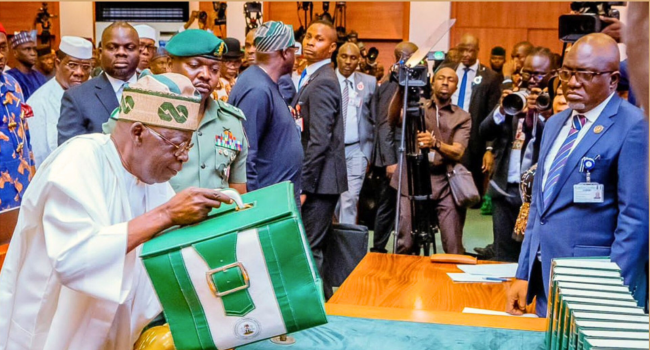
Both the Senate and the House of Representatives passed the appropriation bill during plenary on Tuesday, following a request by President Bola Tinubu to revise the original figures upward.
The president had initially presented a N58.47 trillion budget to the National Assembly of Nigeria in December 2025. However, he later sought an additional N9.81 trillion, citing the need to strengthen fiscal transparency and ensure the smooth execution of priority government programmes.
According to Tinubu, the increase is designed to address long-standing financial obligations carried over from previous budgets. He explained that incorporating these outstanding commitments into the 2026 framework would prevent them from disrupting the new fiscal cycle.
The adjustment also includes provisions to consolidate existing government debts from earlier fiscal periods, allowing room for targeted investments in critical sectors such as transport, healthcare, and institutional capacity.
A significant portion of the revised budget is earmarked for infrastructure development. This includes a federal government equity contribution of N478.6 billion to support presidential light rail projects in Lagos and Kano, as well as feasibility studies for similar urban rail systems in Enugu and Maiduguri.
In addition, N8.6 billion has been allocated for feasibility studies on major transport corridors, including the Calabar–Maiduguri route and the Maiduguri–Sokoto superhighway, part of the administration’s broader national connectivity agenda.
Tinubu noted that these adjustments are also intended to preserve macroeconomic stability while reducing pressure on the domestic credit market. He added that many of the outstanding obligations would likely remain unexecuted before the expiration of the 2025 capital budget window, making their inclusion in the 2026 plan necessary.
Lawmakers in both chambers reviewed and approved the president’s request before passing the budget for a third reading, effectively giving it legislative backing.
The approval builds on earlier fiscal planning decisions by the National Assembly, including the passage of the Medium-Term Expenditure Framework (MTEF) and Fiscal Strategy Paper (FSP) for 2026–2028.
As part of those projections, the House of Representatives initially endorsed crude oil benchmark prices above $64 per barrel across the three-year period. However, the Senate opted for a more conservative approach, revising the 2026 benchmark down to $60 per barrel.
Other key assumptions retained by lawmakers include projected oil production levels of 1.84 million barrels per day in 2026, rising gradually to 1.92 million barrels per day by 2028.
The legislature also approved exchange rate projections of N1,512 for 2026, N1,432.15 for 2027, and N1,383.18 for 2028, alongside inflation forecasts expected to decline from 16.5 percent in 2026 to single digits by 2028.
GDP growth is projected to strengthen over the period, rising from 4.68 percent in 2026 to 7.9 percent by 2028, reflecting expectations of improved economic performance driven by fiscal reforms and infrastructure investment.
With the budget now passed, attention will shift to implementation, as the government faces the challenge of translating ambitious projections into tangible economic outcomes.