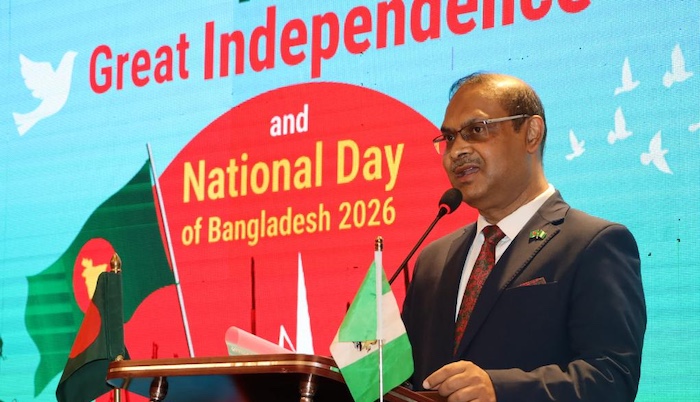
The High Commissioner of Bangladesh to Nigeria, Miah Md. Mainul Kabir, has called for stronger economic cooperation between both countries, expressing concern over the low volume of bilateral trade.
Kabir made the appeal in Abuja during the celebration of Bangladesh’s 55th Independence and National Day, noting that trade between Nigeria and Bangladesh remains far below its potential despite decades of cordial relations.
He said that although commercial exchange has grown steadily, it does not reflect the vast opportunities available to both nations.
“Bilateral trade between our two countries has grown steadily yet remains well below its true potential,” he said, highlighting Bangladesh’s strengths in textiles, pharmaceuticals, ceramics, processed foods, and ICT services.
Kabir also pointed to Nigeria’s large market, energy resources, and agricultural capacity as key areas for expanded engagement.
He identified agriculture, particularly contract farming, as a major opportunity for collaboration, noting that Bangladesh’s expertise in high-yield and climate-resilient farming could complement Nigeria’s vast arable land and agro-processing potential.
The envoy said Bangladesh is intensifying its engagement with African countries, with Nigeria playing a strategic role in that effort.
He added that both countries share strong historical ties, youthful populations, and common aspirations for democratic governance, while also cooperating within international organisations such as the United Nations and the Commonwealth.
Kabir further identified education, skills development, digital innovation, and defence cooperation as additional areas for partnership, stressing the importance of people-to-people engagement to strengthen bilateral relations.
In his remarks, Bukar Hamman of Nigeria’s Ministry of Foreign Affairs reaffirmed Nigeria’s commitment to deepening ties with Bangladesh, highlighting shared values in multilateral cooperation, peacebuilding, and inclusive development.
He noted that collaboration between both countries has expanded in recent years across trade, agriculture, education, and defence sectors, while also encouraging greater private sector involvement.
Hamman added that Nigeria sees significant potential for partnership in areas such as textiles, pharmaceuticals, ICT, and renewable energy.
He expressed confidence that strengthened cooperation would benefit both countries and contribute to broader South–South collaboration and global development.
Michael Olugbode
About the Author