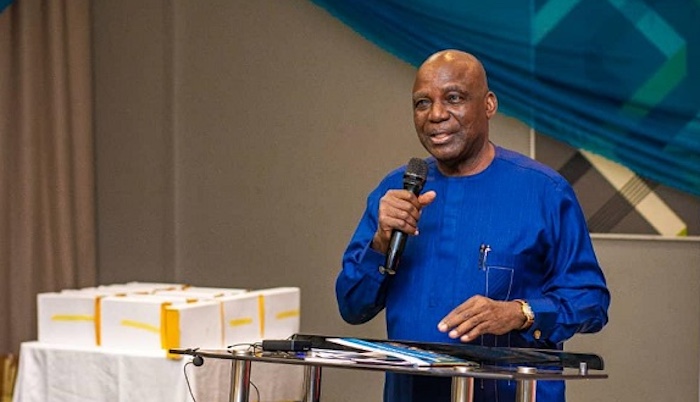
A former Minister of Power, Professor Barth Nnaji, has outlined urgent measures needed to stabilise Nigeria’s struggling electricity sector amid worsening supply challenges.
Speaking at the combined 30th, 31st and 32nd graduation lecture of Abia State University, Uturu, Nnaji said immediate reforms are required to prevent further deterioration of the power industry.
He identified key steps to include the restoration of Power Purchase Agreements (PPAs) between electricity firms and the Federal Government, which were suspended under the previous administration.
Nnaji also called for the settlement of outstanding debts in the sector, including about ₦6.8 trillion owed to power generation companies and over ₦200 billion owed to distribution companies.
He further advocated the introduction of cost-reflective tariffs to ensure the financial viability of the sector.
Other recommendations include the development of a 765KV national super grid and the decentralisation of transmission operations to prevent nationwide blackouts triggered by faults in a single location.
The energy expert also stressed the need to harness Nigeria’s vast natural gas reserves, noting that about 75 per cent of the country’s electricity is generated from thermal sources.
He urged authorities to encourage embedded generation by distribution companies and review their coverage areas to improve efficiency and service delivery.
Drawing comparisons with countries such as India, China, Brazil and the United States, Nnaji lamented that Nigeria has not significantly expanded its power generation capacity in over a decade.
He noted that only a few plants, including the Azura-Edo Power Plant and the Geometric Power Plant in Aba, have been added in recent years.
Nnaji warned that attracting investment into the sector would remain difficult without financial guarantees such as the World Bank-backed Partial Risk Guarantee, which helps reduce investor risk.
He added that the high cost of power generation, estimated at about $1.3 million per megawatt for gas-fired plants, remains a major barrier to new investments.
The former minister also questioned the capacity of state governments to independently drive large-scale power investments despite recent decentralisation under the Electricity Act.
He noted that even with immediate reforms, it would take several years to deliver new power plants, stressing that Nigeria risks falling further behind in electricity generation.
While commending the Federal Government for setting up a committee to recover about 1,600 megawatts of stranded capacity, Nnaji said the country requires up to 100,000 megawatts to achieve a higher-middle-income economy by 2040.
He also supported continued government intervention through subsidies to prevent the collapse of the sector.