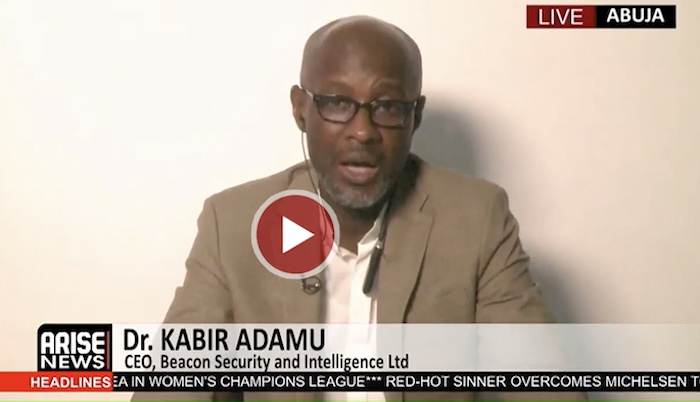
Concerns over Nigeria’s fight against insecurity are deepening as experts highlight how weak institutional systems and poor financial oversight continue to enable money laundering and support criminal activities across the country.
Speaking during an interview on ARISE News on Wednesday, security expert Kabir Adamu said Nigeria’s struggle with insecurity is closely tied to systemic weaknesses that make it difficult to track financial crimes and criminal actors.
He identified the absence of a comprehensive national identification system as a major challenge, noting that “over 100 million Nigerians are not registered,” which significantly limits the government’s ability to trace individuals involved in criminal activities.
Adamu also pointed to poor coordination among agencies handling data, explaining that the lack of harmonisation creates loopholes criminals can exploit. According to him, “there are several other organisations that are also collecting that data,” without an effective system to integrate it.
He further highlighted the scale of Nigeria’s informal economy, describing it as a major channel for illicit financial flows. He stated that the shadow economy “represents over 60% of our GDP,” making it easier for activities such as ransom payments and money laundering to thrive outside regulatory scrutiny.
Despite existing financial regulations, Adamu warned that enforcement remains weak, stressing that “policy [is] good, but… in terms of operations… there is a lot that needs to be done.”
He expressed concern over the role of financial institutions, revealing that ransom payments have been traced to formal banking channels. He described such cases as “preposterous,” noting that transactions occur in institutions where stricter controls are expected.
Adamu also raised issues within the banking sector, particularly the use of contract staff, which he said creates vulnerabilities. According to him, some of these workers are “paid paltry sums” yet have access to systems managing large financial transactions, making them susceptible to compromise.
On digital security, he emphasized the lack of accountability in Nigeria’s online space, warning that criminals exploit this gap to display illicit wealth without consequences. He called for stronger regulatory frameworks, stating that “there is very little accountability” in the digital space.
He urged authorities to focus on improving digital tracking and collaboration with technology platforms, suggesting that platforms operating in Nigeria should be made accountable under local laws.
While acknowledging progress in policy reforms, including Nigeria’s removal from an international financial monitoring grey list, Adamu maintained that more work is needed to translate policy into real enforcement.
He concluded that without stronger institutional coordination, improved digital monitoring, and stricter enforcement mechanisms, money laundering will continue to fuel insecurity across the country.
Triumph Ojo