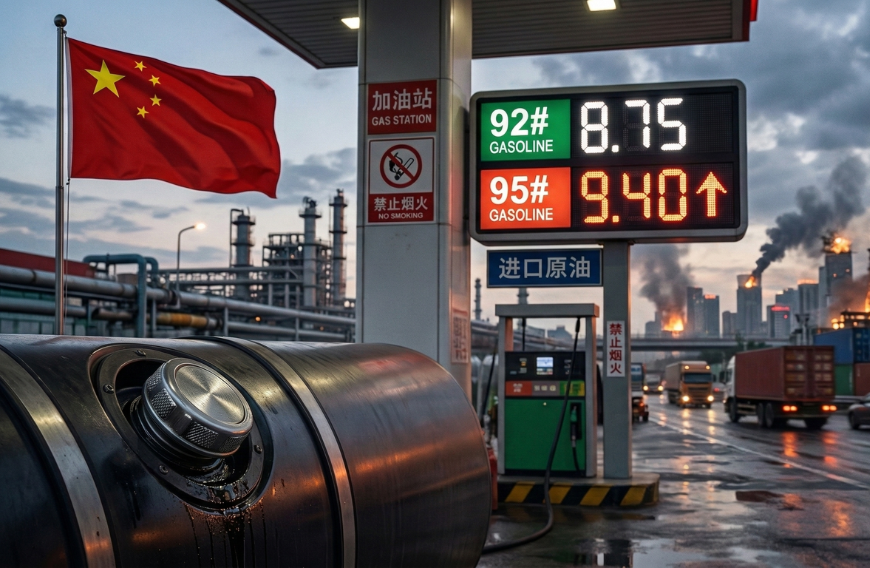
China has scaled back planned fuel price hikes in an effort to “reduce the burden” on drivers, as global energy costs surge following escalating tensions involving Iran.
Domestic petrol prices have risen by about 20% since the start of the conflict, which has seen Iran effectively shut one of the world’s busiest oil shipping routes, the Strait of Hormuz.
Authorities had initially set gasoline and diesel price increases at 2,205 yuan (£239; $320) and 2,120 yuan per tonne respectively. After government intervention, the hikes were almost halved to 1,160 yuan and 1,115 yuan, taking effect from Tuesday.
More than 300 million motorists in China rely on petrol or diesel vehicles, with Gulf nations accounting for a significant share of the country’s crude oil imports.
Over the weekend, long queues formed at petrol stations in several major cities, while some outlets posted notices indicating they had run out of fuel. Despite the adjustment, the latest increase remains the country’s fifth and largest price rise this year.
Global oil markets have been volatile, with Brent crude prices climbing above $100 per barrel on Tuesday, a day after falling sharply on mixed signals over potential US Iran talks.
Analysts note that Beijing has built substantial strategic oil reserves over the years by capitalising on lower global prices and abundant supply from Gulf producers. Ole Hansen, Saxo Bank’s head of commodity strategy, told the BBC last week that China has accumulated one of the world’s largest stockpiles.
Data from China’s customs administration showed crude purchases in January and February rose by 16% compared with the same period last year. Iran, whose oil exports face US sanctions, has remained a major source of discounted supply, with reports suggesting China buys more than 80% of Iran’s shipments.
Estimates cited by Hansen suggest China’s reserves stand at around 900 million barrels, equivalent to nearly three months of imports. Figures from Columbia University, reported by Chinese state media, put petrol stockpiles at about 1.4 billion barrels.
Despite these buffers, authorities have moved cautiously to manage short term supply pressures. Reports indicate Beijing has instructed refineries to suspend fuel exports temporarily to stabilise domestic prices, although officials did not respond to BBC queries on the claim.
According to the US Energy Information Administration, crude shipments from Saudi Arabia and Iran each account for more than 10% of China’s imports.
“To mitigate the impact of abnormal increases in international oil prices, ease the burden on downstream users and ensure stable economic operations and public welfare, temporary regulatory measures have been adopted,” China’s state planner said in a statement on Monday.
Fuel price adjustments are overseen by the National Development and Reform Commission, which reviews petrol and diesel rates every 10 days in line with global crude trends.
Across Asia, governments are introducing emergency measures to cushion the impact of rising energy costs. In the Philippines, civil servants have been directed to work a four day week, while Sri Lanka has declared Wednesdays public holidays to conserve fuel. Authorities in Thailand and Vietnam have encouraged remote working.
Thai officials have also suspended overseas travel, advised workers to wear short sleeve shirts and urged the use of stairs instead of lifts to cut electricity consumption.
Sri Lanka’s private bus sector was nearly paralysed on Monday after operators launched strike action demanding fare adjustments to offset higher fuel costs. In the Philippines, more than 20 transport groups have announced a two day strike from March 26 to 27.
Japan and South Korea have been particularly exposed to supply disruptions linked to the Strait of Hormuz. Japan’s average retail petrol price hit a record high last week, rising to 191 yen (£0.90; $1.20) per litre on Monday, an 18% weekly increase, according to the country’s economy ministry.
South Korean President Lee Jae Myung on Tuesday said public institutions would cut back on passenger vehicle use. His office also confirmed he had cancelled plans to attend an international forum in China in order to “lead the emergency economic response directly and make swift decisions at this juncture”.
Faridah Abdulkadiri