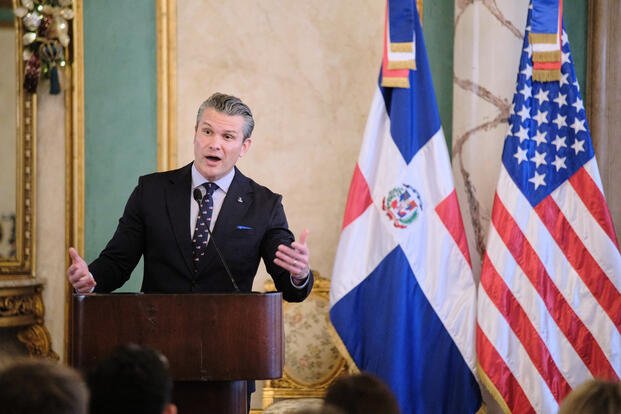
The Dominican Republic has authorised the United States to use two of its major air facilities as part of Washington’s increasingly aggressive operations against alleged drug traffickers—operations that have reportedly resulted in more than 80 deaths so far.
The announcement was made on Wednesday during U.S. Defense Secretary Pete Hegseth’s visit to Santo Domingo, as Washington intensifies pressure on Venezuelan President Nicolás Maduro, whom it accuses of leading a powerful narcotics syndicate.
President Luis Abinader, speaking at a joint press conference with Hegseth, confirmed that the U.S. military would be permitted to use restricted areas at the San Isidro Air Base and Las Americas International Airport for logistical purposes.
“We have authorised the United States, for a limited time, to use restricted areas at the San Isidro Air Base and the Las Americas International Airport for logistical operations, including refueling and the transport of personnel and equipment,” Abinader said.
Hegseth reinforced the message, confirming the temporary deployment of U.S. aircraft and service members, and emphasised Washington’s renewed hardline stance on counter-narcotics operations.
“We’re deadly serious about this mission,” he declared. “In fighting narco-terrorists, we must go on the offensive—decisively and relentlessly. It’s the only language they understand.”
A Major Military Build-Up in the Region
The agreement comes as the U.S. ramps up military pressure in the Caribbean following its designation of the alleged Venezuelan network Cartel de los Soles (Cartel of the Suns) as a foreign terrorist organization.
The designation grants the White House expanded legal authority for operations targeting Venezuelan officials.
Since early September, Washington has been conducting lethal strikes on what it claims are drug-smuggling vessels—over 20 boats have been destroyed. Experts, however, warn that many of the killings qualify as extrajudicial executions, noting that the U.S. has presented no public evidence that the individuals targeted were drug traffickers or posed any threat.
President Donald Trump has further escalated the mission by deploying the world’s largest aircraft carrier along with ten naval ships to the Caribbean—an unprecedented show of force for an anti-trafficking operation. Additionally, U.S. B-52 and B-1B strategic bombers have made repeated flights near Venezuela’s coastline.
These actions have heightened tensions across the region. Maduro has accused the U.S. of weaponising anti-drug efforts to justify “regime change” and seize control of Venezuela’s vast oil reserves.
“There is no drug cultivation in Venezuela,” Maduro maintains, arguing that the country is used involuntarily as a transit route for Colombian cocaine.
Dominican Republic Deepening Support
The Dominican Republic has long cooperated with U.S. anti-drug initiatives. Earlier this month, authorities announced the seizure of 500 kilograms of cocaine from a vessel intercepted during a joint operation with U.S. forces.
The Caribbean nation, which shares the island of Hispaniola with Haiti, is considered a strategic location in regional counter-narcotics efforts—now further cemented by its decision to open its air facilities to U.S. operations.