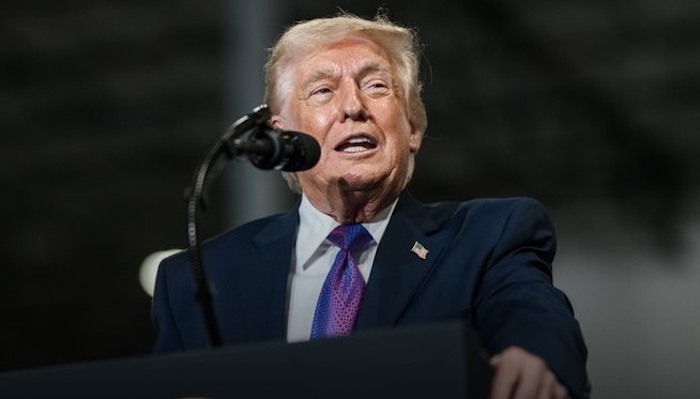
US President Donald Trump says the United States Navy has cleared mines from the Strait of Hormuz and now has “100%” control of the strategic waterway, as Washington and Tehran clash over conditions for reopening the route.
Speaking to reporters in the Oval Office on Monday, Trump said the strait was now open and that the United States was “the only one that has control” of the waterway.
Trump described the US naval presence as a “steel wall”, saying occasional attempts by Iran to lay mines had not disrupted American control.
“They will, on occasion, drop a mine, and we find the mine,” Trump said, adding that the United States had maintained a naval blockade of Iranian ports since mid-April.
However, Iran has maintained that the Strait of Hormuz will remain closed until Washington meets a series of demands, including lifting the naval blockade and sanctions, withdrawing US forces from the region, paying war reparations and releasing frozen Iranian assets.
Iranian officials have also demanded an end to US attacks on Tehran’s regional allies.
The dispute escalated further after Trump, in a Truth Social post early Tuesday, rejected Iran’s demand for war-damage compensation and suggested that Tehran should instead compensate the United States.
Trump said Iran should pay for Americans killed or wounded in roadside bombings and other attacks allegedly linked to Tehran, as well as Iranian protesters he said had been killed by the Iranian regime over the past five decades.
The demand has emerged as a new sticking point in efforts to resolve the standoff over the Strait of Hormuz, a critical global shipping route that carried roughly one-fifth of the world’s oil before the conflict.
Mohammad Bagher Zolghadr, secretary of Iran’s Supreme National Security Council, said on Saturday that the strait would not reopen until Washington lifted its naval blockade and sanctions, withdrew its forces from the region, paid war reparations and released Iranian assets frozen abroad.
Meanwhile, Iran has pushed back against mounting US economic pressure.
Foreign Ministry spokesman Esmaeil Baqaei responded on Tuesday to US Treasury Secretary Scott Bessent’s claim that American sanctions were “suffocating” Iran, accusing Washington of repeatedly turning to sanctions when diplomacy fails.
Baqaei said the United States escalates sanctions when they fail to achieve their objectives, describing the approach as less of a policy and more of a “compulsive addiction.”
The deadlock has left Washington viewing its naval presence as a permanent guarantee of access through the waterway, while Tehran considers the same presence the main obstacle to restoring normal shipping.
Market concerns over disrupted energy supplies have also intensified, with tanker traffic through the strait remaining subdued.
Lloyd Chan, senior currency analyst at MUFG Bank in Singapore, said Brent crude prices remained significantly above pre-conflict levels, although he noted that a wider regional war was still not the base-case scenario.
Oil prices rallied sharply on Monday as tensions between Washington and Tehran hardened.
West Texas Intermediate crude for September delivery rose about five per cent to settle at around $82.13 a barrel, while Brent crude gained a similar margin to about $87.72.
Oil prices edged higher again in Asian trading on Tuesday.
Boluwatife Enome