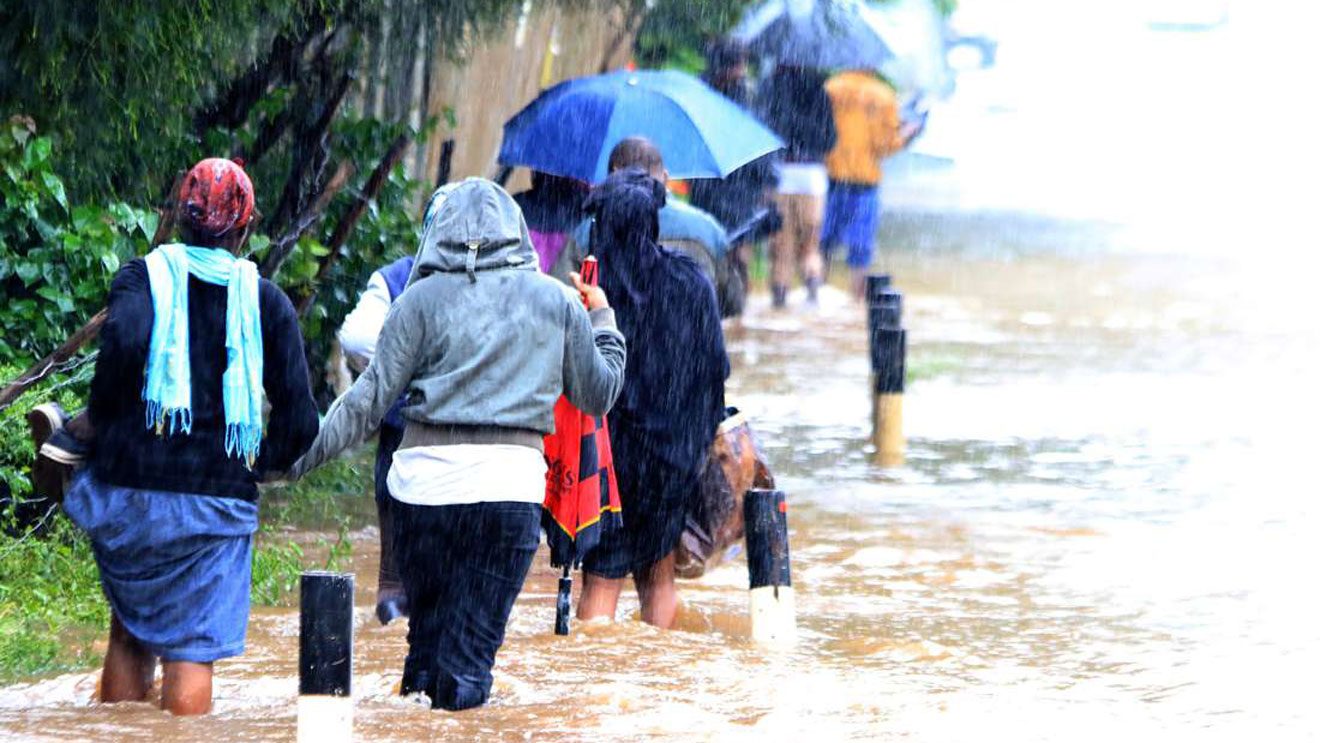
The government has classified 18 counties as being at high risk of flooding during the October–November–December (OND) short rains season.
The National Disaster Operations Centre (NDOC), the government’s agency that coordinates national emergency response, disaster risk reduction, and 24/7 crisis monitoring, said in a press statement that the identified counties have been prioritised in the response plan based on their vulnerability to El Niño-related risks.
Counties in the Rift Valley, Lake Basin, Coast and North Eastern regions are among the areas that could be worst hit. Major cities including Nairobi, Mombasa and Kisumu are among the high-risk urban hotspots.
“In the Coast Region, Tana River, Kilifi, Lamu, Mombasa and Kwale may experience flooding, storm surges, coastal erosion and infrastructure damage. Residents of some areas in the region may be displaced by floods. In the Lake Basin region, Kisumu, Busia, Siaya, Homa Bay and Migori are expected to experience flooding, landslides, disease outbreaks and cases of displacement,” the agency warned.
Residents of Nairobi, Mombasa and Kisumu are at risk of flooding, drainage blockages, strain on infrastructure and disruptions to essential services, according to NDOC.
“In the Rift Valley Region, counties such as Turkana, Baringo, West Pokot and Narok may experience drought, flash floods, landslides, livestock losses and food insecurity. The North Eastern Region counties of Garissa, Wajir and Mandera may experience drought, water scarcity, livestock losses, poor pasture and food insecurity.”
Hannah Kimani, assistant director for public weather services at the Kenya Meteorological Service Authority (KMSA), told the Nation that El Niño conditions are already present and that the country is likely to experience above-average rainfall, which may cause flooding.
“El Niño is expected to intensify with an 85 percent probability, and it is expected to be a strong El Niño with a possibility of spilling over into early 2027,” she said.
A separate projection by the Food and Agriculture Organization (FAO), the World Food Programme (WFP) and KMSA, dubbed the “FAO-WFP El Niño 2026/27 Anticipatory Impacts” report, puts that number at 23 counties. They include Turkana, Samburu, Marsabit, Isiolo, Mandera, Wajir, Garissa, Tana River, Lamu, Kilifi, Taita Taveta, Kitui, Makueni, Machakos, Kajiado, Narok, Kisumu, Homa Bay, Migori, Busia, Siaya, Kakamega and Vihiga.
Arid and semi-arid areas and the coast are expected to be hit hardest.
What Kenya’s El Niño history shows
The 1997/98 El Niño remains the reference point for Kenyan disaster planners. Heavy rains from October 1997 through February 1998 caused floods that aid agencies at the time described as having affected food production and infrastructure across eastern Africa, with significant loss of life in Kenya.
The floods triggered a Rift Valley Fever outbreak in north-eastern Kenya and southern Somalia, with an estimated 89,000 human cases and between 200 and 250 deaths from the disease alone, according to a peer-reviewed assessment of the event’s health and economic consequences. A separate malaria outbreak in north-eastern districts in early 1998 caused at least 1,500 reported fatalities, the same assessment found.
In the 2023/24 El Niño floods, the death toll rose through the season as the rains continued — from 76 in late November 2023, to 120 by the end of that month, to 160 in early December, reaching at least 174 by December 20, 2023, according to the UN Office for the Coordination of Humanitarian Affairs (OCHA). More than half a million people were displaced. Thirty-eight of Kenya’s 47 counties were affected by a mix of riverine flooding, flash floods and landslides, with roughly 90 percent of those affected concentrated in Mandera, Garissa, Tana River, Wajir, Isiolo and Meru counties, OCHA reported. Tana River and Garissa, among the hardest hit in 2023/24, are on both risk lists again this season.
The government’s current plan to pre-position boats in flood-prone areas echoes a similar pledge Nairobi County made ahead of the 2023/24 El Niño season.
In October 2023, Bramwell Simiyu, then chairman of Nairobi County’s El Niño taskforce, announced that the county would procure motorboats, rafts and inflatable boats within the following week. The announcement was met with public skepticism, including from Nairobi Governor Johnson Sakaja, who responded on social media with laughing emojis and the word “surely.” Nairobi Senator Edwin Sifuna also questioned the credibility of the plan, saying it was hard to believe.
Current preparedness push
Beyond Nairobi, Secretary to the Cabinet Mercy Wanjau said the national government intends to deploy boats and other emergency equipment to areas where terrain makes large water accumulation likely, in order to keep roads passable and ensure continued access to food, clean water and medication. The government is also clearing drainage systems and protecting roads and bridges.
“To be aware is to be forewarned. To be forewarned is to train and prepare,” Wanjau said, urging Kenyans — including urban households with kitchen gardens — to take up climate-smart agriculture to cushion against food shortages after flooding.
Separately, FAO and WFP are seeking $202 million (about Sh26.1 billion) in anticipatory funding for Kenya, Somalia, Ethiopia, Sudan, South Sudan and Uganda, where the agencies say roughly 8.8 million people across East Africa are at risk from El Niño-related flooding, landslides and worsening food insecurity, according to Dr Pierre H. Kamsu Tamo of the African Centre of Meteorological Applications for Development (Acmad), speaking at a meeting convened by FAO, WFP and Agra.
FAO warns that without adequate preparation, the impacts could resemble the 1997/98 floods or the 2023 flooding that followed the 2020–2023 drought. The joint FAO-WFP report recommends clearing drainage systems, activating flood preparedness protocols, relocating people in high-risk areas, strengthening flash flood early warning systems, improving urban drainage, expanding mobile healthcare and promoting agricultural, health and property insurance.
“There is a need to protect people’s lives, property, livestock and crops. Where losses occur, blended financing solutions, including insurance, are critical,” said Dominique Reumkens, FAO resilience specialist, who added that improved forecasting, timely early warnings, pre-arranged financing and wider insurance coverage would reduce disaster losses and speed recovery.
Adoption of crop and livestock insurance in Kenya remains critically low, estimated at less than one percent among smallholder farmers and pastoralists outside fully subsidised government or pilot programmes.
Brenda Lazarus, food security and early warning economist at FAO, said El Niño affects African countries differently depending on location and season, with parts of eastern Africa still recovering from the prolonged drought experienced earlier this year.
“The FAO-WFP joint appeal seeks to protect both livelihoods and food production by supporting anticipatory actions before disasters occur,” she said.
The agencies also warn that climate change is raising the likelihood and severity of El Niño-related hazards, including flash floods, outbreaks of water-borne disease, soil erosion, crop destruction and livestock losses — which may later be followed by prolonged dry spells, extreme heat and an increased risk of cardiovascular, respiratory and maternal and child health problems.