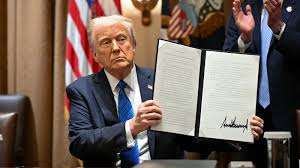
U.S. President Donald Trump has renewed his effort to limit birthright citizenship by signing two new executive orders aimed at tightening citizenship rules for children born to certain non-citizen parents and curbing so-called “birth tourism,” weeks after the U.S. Supreme Court rejected his previous attempt to narrow the constitutional right.
The latest measures represent the administration’s newest strategy to reshape U.S. immigration policy after the Supreme Court reaffirmed that birthright citizenship, as protected under the 14th Amendment, remains the law of the land.
One of the executive orders expands the categories of non-citizens whose U.S.-born children would not automatically qualify for citizenship. Under the new policy, the restriction applies in cases where both parents are non-citizens and one parent is alleged to be affiliated with a foreign terrorist organisation, employed by a foreign government, accused of attempting to obtain U.S. immigration status through fraud, or residing in a U.S. territory where citizenship is not conferred under federal law.
The second executive order targets birth tourism—the practice of foreign nationals travelling to the United States primarily to give birth so their children acquire U.S. citizenship.
The administration argues that the policy is intended to prevent abuse of the immigration system and strengthen national security by reducing opportunities for foreign actors to exploit birthright citizenship.
The White House has repeatedly argued that birth tourism has been used by individuals from countries considered strategic rivals, including Russia and China, to secure long-term immigration benefits through their U.S.-born children. However, publicly available research suggests the scale of the practice is relatively limited.
According to the nonpartisan Migration Policy Institute, census-based estimates indicate that between 22,000 and 26,000 babies are born annually in the United States through birth tourism. Government data cited by the institute also recorded about 9,600 births to mothers with foreign addresses in 2024.
The administration maintains that existing provisions of the Immigration and Nationality Act grant the President authority to restrict entry into the United States for individuals travelling primarily for childbirth. Legal experts generally agree that immigration authorities have broad discretion over visa eligibility and admission decisions, including efforts to curb birth tourism.
However, constitutional scholars note that preventing entry for the purpose of birth tourism differs significantly from denying citizenship to a child born on U.S. soil. Many legal experts argue that citizenship rights established under the 14th Amendment cannot be altered through executive action alone.
Trump first sought to restrict birthright citizenship shortly after returning to office in 2025, signing an executive order that attempted to reinterpret constitutional protections governing citizenship by birth. That policy was challenged in court and ultimately rejected by the U.S. Supreme Court in June, which left the long-standing interpretation of the 14th Amendment intact.
The administration’s latest executive actions are widely expected to trigger another round of legal challenges, with constitutional experts predicting renewed scrutiny over whether the President has the authority to limit birthright citizenship without congressional action or a constitutional amendment.
The renewed effort underscores immigration’s central role in Trump’s second-term agenda as the administration continues pursuing stricter border enforcement and broader changes to U.S. immigration policy despite significant legal hurdles.