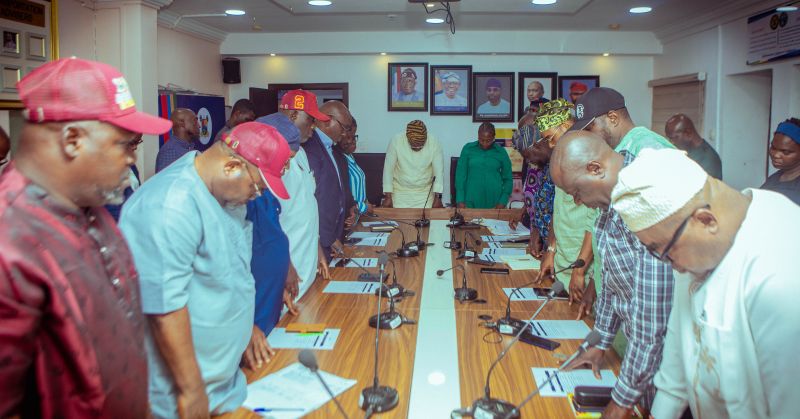
The Lagos State Government has signed a Memorandum of Understanding (MoU) with the Nigeria Union of Road Transport Workers (NURTW) and the Road Transport Employers Association of Nigeria (RTEAN) to transition commercial bus operators into a regulated public transport system under the state’s Bus Industry Transition Programme (BITP).
The agreement, announced by the Lagos Metropolitan Area Transport Authority (LAMATA) on Wednesday, is expected to integrate informal commercial transport operators, including the iconic yellow danfo buses, into a structured and modern public transport network while laying the foundation for a franchise-based bus operating system across the state.
According to LAMATA, the MoU represents a major milestone in the implementation of the Bus Industry Transition Programme, a Lagos State Government initiative designed to modernise public transportation by bringing informal operators into a regulated framework.
The agency said the agreement provides the operational framework for transitioning bus services across Lagos’ eight Quality Bus Corridors (QBCs) and granting bus operating franchises under the new system.
“The two major transport unions in Lagos State—the Nigeria Union of Road Transport Workers (NURTW) and the Road Transport Employers Association of Nigeria (RTEAN)—have signed a landmark Memorandum of Understanding (MoU) to participate in the Lagos State Bus Industry Transition Programme (BITP), marking a significant milestone in the transformation of public transportation in the state,” LAMATA said.
It added that the programme would integrate informal commercial transport operators, including danfo buses, into “a regulated, structured, and modern public transport network.”
The MoU was signed by the Permanent Secretary of the Lagos State Ministry of Transportation, Olawale Musa, LAMATA Managing Director, Abimbola Akinajo, and representatives of both transport unions.
Under the new arrangement, transport unions will adopt a cooperative governance structure to facilitate the transition of their members into franchise operators. Fare collection will also migrate to a fully digital payment system, while LAMATA will retain responsibility for regulating bus operations.
LAMATA said the programme would commence on selected corridors before expanding across the state. Four Quality Bus Corridors are already under construction to support the rollout, including Iju Ishaga–Abule Egba, Ketu–Alapere–Akanimodo, Iyana Iba–Igando–Iyana Ipaja, and Ojuelegba–Lawanson–Cele.
Speaking on the agreement, LAMATA Managing Director Abimbola Akinajo said the MoU followed more than 30 months of consultations with transport unions and would position Lagos as a model for cities seeking to modernise public transportation.
“Formalization should not be construed as strangulation. When we collaborate, the result will be formidable and capable of being replicated across other parts of Nigeria and in cities around the world that are seeking to formalize their public transport operations,” she said.
Permanent Secretary, Ministry of Transportation, Olawale Musa, described the agreement as “a new beginning for public transport in this state,” saying it demonstrates the commitment of the state government and transport stakeholders to building a safer, more efficient and sustainable transport system.
LAMATA said the Bus Industry Transition Programme is expected to improve service quality, strengthen regulatory oversight, promote cashless fare payments and create a more sustainable public transport network.
Lagos has expanded regulated public transportation in recent years through the Bus Rapid Transit (BRT) network, First and Last Mile buses and other government-backed services. However, these have struggled to meet the mobility demands of the state’s rapidly growing population, leaving many commuters dependent on informal operators such as danfo and korope buses.
The state has introduced a series of reforms to improve safety standards and strengthen regulation of the sector, including restricting operations on the Lekki-Epe corridor to buses meeting Vehicle Inspection Service standards, introducing regulated cashless bus services through the Cowry Card, and limiting access for informal operators.
Boluwatife Enome