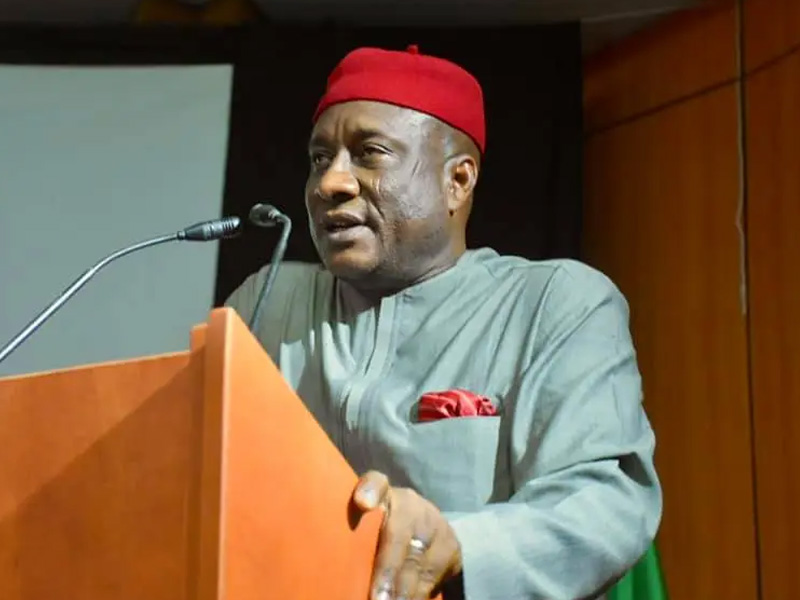
The Chairman and Chief Executive Officer of Air Peace Limited, Dr. Allen Onyema, has cautioned aviation unions against embarking on actions that could cause prolonged disruption to airline operations and further weaken Nigeria’s domestic aviation industry.
Onyema was reacting to threats by aviation unions to picket airlines over debts allegedly owed to the Nigerian Civil Aviation Authority (NCAA).
He said airlines and the regulator had already agreed on payment arrangements to liquidate the debts, which he said accumulated during the United States-Iran conflict when the price of aviation fuel rose from about ₦900 per litre to ₦3,500.
Speaking at the launch of a book written by the Chairman of Med-View Airline, Muneer Bankole, in Lagos, Onyema said domestic airlines operate under some of the most difficult conditions globally and should deal directly with the NCAA rather than labour unions.
He described attempts by unions to picket airlines or recover debts on behalf of government agencies as an aberration without global precedent, warning that disruptions to airline operations could pose safety risks.
“We don’t have any problem with the unions, neither do we have business with them. We have business with the NCAA, and we have been complying with what the NCAA directs us to do. If anybody thinks they can use unions to intimidate airlines in this country, they are wasting their time,” Onyema said.
He highlighted the severe financial pressures facing domestic operators, including borrowing rates of between 30 and 33 per cent, multiple taxes and charges, high insurance premiums and foreign exchange-dependent maintenance costs.
Onyema called for a national review of the reasons more than 50 domestic airlines had collapsed over the years, despite being established by entrepreneurs who succeeded in other sectors.
He said the International Air Transport Association had repeatedly identified Nigeria as one of the most difficult and expensive environments in which to operate an airline because of high operating costs, excessive taxes, multiple charges, statutory levies, high insurance premiums and expensive credit.
“Why don’t we do self-introspection to find out and tell ourselves the truth? Why are these airlines failing? The owners of these airlines succeeded in other businesses, but failed in the airline business. We don’t need IATA or any foreigner to remind us what we are suffering from,” he said.
Onyema also pointed to infrastructure deficiencies at Nigerian airports, disclosing that Air Peace recorded 56 bird strikes within one year, some of which caused severe damage to aircraft and required expensive engine replacements.
He argued that airlines pay statutory fees for infrastructure and services that are sometimes not adequately provided, resulting in aircraft downtime, physical damage and revenue losses.
“Part of the money we pay is for certain infrastructure to be provided. Now, if the infrastructure is not provided and the airlines keep losing revenue as a result, how do they pay vendors? Then union members will go and picket airlines, saying it is because airlines could not pay. I have never heard of such a thing anywhere in the world,” Onyema said.
He warned that domestic airlines were already under intense pressure and could be forced to ground operations if unions attempted to shut them down.
“He who is on the ground fears no fall. The airlines are already on the ground. If they want to come and destroy the airlines, let them come and do it, and we all go home. We will unleash hundreds of thousands of staff to the public, and let all of them become jobless if that is the best way to solve the problem,” he said.
Onyema maintained that domestic airlines remain committed to safety and national service, urging regulators and the Ministry of Aviation and Aerospace Development to continue engaging operators directly on industry challenges.
Chinedu Eze