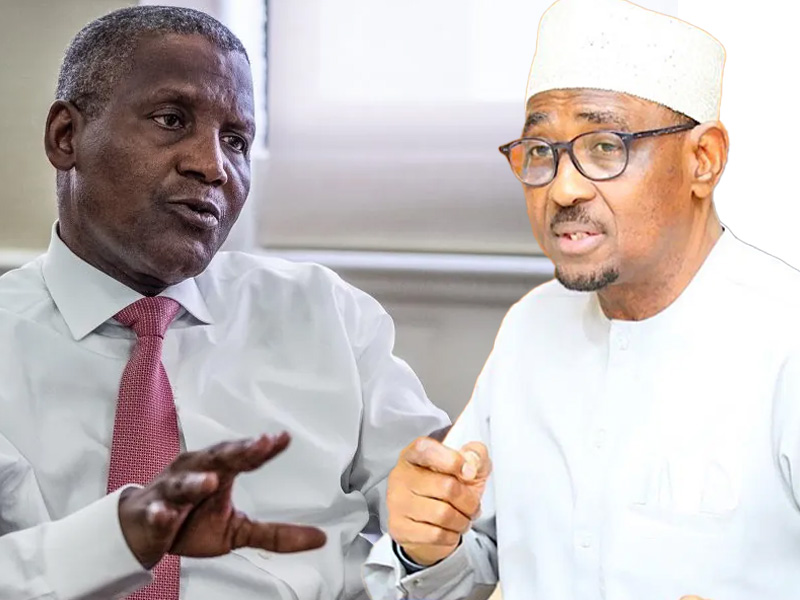
Africa’s richest man, Aliko Dangote, Tuesday doubled down on his allegations of graft and economic sabotage against the Chief Executive of the Nigerian Midstream and Downstream Petroleum Regulatory Authority (NMDPRA), Farouk Ahmed, dragging him (Ahmed) before the Independent Corrupt Practices and Other Related Offences Commission (ICPC).
Also Tuesday, the anti-corruption agency confirmed that it received a formal petition from the President of Dangote Industries Limited (DIL) through his lawyer against the CEO of the NMDPRA, Ahmed, over the alleged payment of $7 million as school fees for his children in a foreign educational institution.
“The ICPC wishes to state that the petition will be duly investigated,” a statement by the commission’s spokesman , John Odey, emphasised last night.
In the same vein, an earlier statement purportedly released by Ahmed explaining how he sourced the funding for the education of his children overseas was curiously withdrawn in the early hours of Wednesday.
In the disclaimer he personally signed, Ahmed stated: “My attention has been drawn to a purported response I was said to have made on the recent allegations against my person. I hereby state categorically that the so-called statement did not emanate from me.
“While I am aware of the wild and spurious allegations made against me and my family and the frenzy it has generated, as a regulator of a sensitive industry, I have opted not to engage in public brickbat. Thankfully, the person behind the allegations has taken it to a formal investigative institution. I believe that would provide an opportunity to dispassionately distill the issues and to clear my name.”
Besides, the House of Representatives has resolved to probe the NMDPRA chief executive over the issue of payment of the millions of dollars in tuition fees for his children abroad as well as the indiscriminate issuance of importation licenses for petrol despite availability of the product locally.
But in the petition submitted through his lawyer, Chief Ogwu Onoja (SAN), Dangote specifically called on the ICPC to arrest, investigate and prosecute the oil sector regulator for offences bordering on corruption and financial impropriety in the performance of his duties as CEO of the petroleum regulatory agency.
The petition which was submitted to the office of the ICPC Chairman, Musa Aliyu (SAN), alleged that Ahmed spent over $7 million on the education of four of his children in Switzerland.
According to the petition, a copy which was seen by THISDAY, the NMDPRA boss paid his children’s fees up-front, without any lawful source of income to justify such expenditure.
Besides, it was the claim of the petitioner that the NMDPRA boss grossly abused his office contrary to the extant provisions of the Code of Conduct for public officers and by so doing enmeshed himself in monumental corruption and unlawful spending of public funds running into millions of dollars.
“That Farouk Ahmed spent without evidence of lawful means of income a humongous amount of money of over 7 million dollars of public funds for the education of his four children in different schools in Switzerland for a period of six years upfront,” the petition read in part.
To buttress his allegations Dangote gave the names of the four children, the Swiss schools they attend, the amount paid for each of them, to the ICPC for verification and confirmation.
The business mogul further alleged that Ahmed used the instrumentality of the NMDPRA to embezzle and divert public funds for personal gain and private interests, actions he claimed had fuelled public outrage and recent protests by various groups.
Attempting to substantiate the corruption allegations, Dangote pointed out that the NMDPRA boss spent his entire adult working life in the Nigerian public sector and as such could not, based on his legitimate earnings over the years, have accumulated funds close to the alleged $7 million used to finance his children’s education abroad.
“It is without doubt that the above facts in relation to abuse of office, breach of the Code of Conduct for public officers, corrupt enrichment and embezzlement are gross acts of corrupt practices for which your Commission is statutorily empowered under Section 19 of the ICPC Act to investigate and prosecute,” Dangote said.
According to Dangote, Ahmed has corruptly enriched himself with tax payersmoney meant for public consumption and diverted them into private uses.
He argued: “Any public officer who uses his office or position to gratify or confer any corrupt or unfair advantage upon himself or any relation or associate of the public officer or any other public officer shall be guilty of an offence and shall on conviction be liable to imprisonment for five years without option of fine”.
The petitioner expressed confidence in the capacity of the ICPC, working alongside other anti-corruption agencies, to prosecute financial crimes and ensure that offenders are punished once a prima facie case is established.
He therefore urged the commission to act decisively by investigating the allegations against Ahmed and prosecuting him if found culpable, stressing that the matter is already in the public domain. According to the petition, decisive action by the ICPC would help uphold justice and protect the image of the administration of President Bola Tinubu.
He also vowed to provide evidence to substantiate his allegations of corrupt enrichment, abuse of office and impunity against the NMDPRA chief.
Meanwhile, the House of Representatives has resolved to probe Ahmed over the issue of payment of tuition fees for his kids abroad.
The Green Chamber also resolved to investigate the allegations made by Dangote against Ahmed over indiscriminate issuance of importation licenses for petrol despite availability of the products locally.
The resolution of the House was sequel to the adoption of a motion moved at the plenary on by Midala Usman.
Presenting the motion, Usman explained that Section 88 (1) and (2) of the Constitution empowers the National Assembly to conduct investigations into the activities of any authority executing or administering laws made by the National Assembly.
He added that Section 29 (3) of the Petroleum Industry Act 2021 provides that NMDPRA shall be responsible for the technical and commercial regulation of the midstream and downstream petroleum operations in the petroleum industry.
The lawmaker said the House was aware of the dispute between the NMDPRA and Dangote Refinery over alleged arbitrary grant of importation licenses, allegation of corruption against Ahmed and other sundry issues.
Usman expressed worry that if the brewing dispute between the NMDPRA and Dangote Refinery is not nipped in the bud, it is likely to escalate and thus lead to fuel supply crisis during the Yuletide season and beyond.
He noted that the Dangote Refinery represents a strategic national investment poised to end Nigeria’s historical dependence on imported petrol, conserve foreign exchange, stabilise domestic supply, and moderate fuel pricing in the long term.
The lawmaker expressed worry that unresolved regulatory disagreements between a statutory regulator and the country’s largest domestic refinery pose a real risk of supply chain disruption, pricing volatility, policy inconsistency, and erosion of investor confidence in Nigeria’s petroleum sector.
Usman lamented that the absence of a clearly articulated, transparent, and consistently applied petrol pricing framework creates room for arbitrary determinations, and market distortions to the detriment of Nigerian consumers.
He argued that Nigerians continue to experience frequent petrol price fluctuations without adequate public disclosure of: Refinery gantry prices; regulatory pricing assumptions, cost and margin components, and the comparative impact of local refining versus import-based pricing.
According to him, energy security, downstream stability, and consumer protection cannot be achieved where regulatory uncertainty and pricing opacity persist.
He stressed that urgent legislative investigation is required to clarify regulatory boundaries, harmonise pricing expectations, and restore confidence in Nigeria’s downstream petroleum governance architecture.
The House, therefore, mandated the Committees on Petroleum Resources (Midstream) and (Downstream) to investigate the root causes of the dispute and report within four weeks for further legislative action.
Emmanuel Addeh, Alex Enumah and Adedayo Akinwale
About the Author